



Stablecoins, a form a tokenized money issued primarily by non-banks, promise efficiency gains in payments, but also introduce new risks to financial stability and monetary control.
Because of this, policymakers in the European Union (EU) have largely discouraged their development, favoring instead tokenized deposits issued by banks. According to a new paper by Bruegel, a European economics think tank, this stance risks driving stablecoin activity offshore and exposing EU holders to USD currency risk and the bloc itself to the risk of “infrastructure dollarization”.
The EU’s stance on stablecoins
Under the 2023 Markets in Crypto Assets regulation (MiCA), the EU has set a clear policy direction that favors the development of private-sector digital money within the architecture of the existing monetary system, such as tokenized deposits and stablecoins issued by banks, while discouraging the development of stablecoins outside that architecture, the paper says.

The European Central Bank (ECB) has acknowledged the technological possibilities offered by digital money, while also warning of the risks to financial stability and monetary policy transmission created specifically by stablecoins.
Conversely, the US has taken a difference stance. Although the 2025 US Genius Act has much in common with MiCA, it actively encourage the development of USD stablecoins, the paper says.
It argues that while EU policymakers aim to protect the architecture of the euro-area financial system and maintain the sovereignty of the currency, they may unintentionally achieve the opposite. By discouraging the development of stablecoins, the EU could push demand to the US, exposing the bloc to the risk of “infrastructure dollarization” and of an over-reliance on the USD and US-controlled networks rather than domestic currency and infrastructure.
Consequently, Europe could be left without a competitive distributed ledger technology (DLT) payment infrastructure anchored in EU public money. This gap would emerge during the critical period when global norms are established for tokenized payments.
A strategy to contain these risks
To mitigate these risks, Bruegel advises supporting of the development of euro-denominated, EU-regulated stablecoins, while ensuring their safety and preserving the role of central-bank money in the euro area’s financial architecture.
This would require ensuring public settlement for tokenized markets, including by accelerating the ECB’s Appia project to establish interoperability between DLT platforms and ECB payments infrastructure.
Launched in 2025, Appia is the cornerstone of the Eurosystem strategy to provide central bank money within tokenized wholesale financial markets, leveraging DLT to preserve central bank money as the anchor of the monetary system, foster a more integrated and resilient financial ecosystem, ensure strategic autonomy, and maintain the euro’s relevance as an international currency.
Bruegel also recommends introducing measures to increase the liquidity of euro stablecoins on secondary markets, and removing MiCA requirements to hold a large share of stablecoin reserves in the form of bank deposits.
Additionally, the think tank proposes allowing EU stablecoin issuers to remunerate stablecoin holders directly as long as the remuneration rate is below the rate on ECB reserves and standard deposit rates. Finally, it recommends granting EU-regulated stablecoin issuers access to the ECB’s balance sheet, including to lending-in-last-resort facilities. This would ensure that stablecoin issuers receive emergency funding during a crisis, preventing their collapse from destabilizing the broader financial system.
The dominance of USD-denominated stablecoins
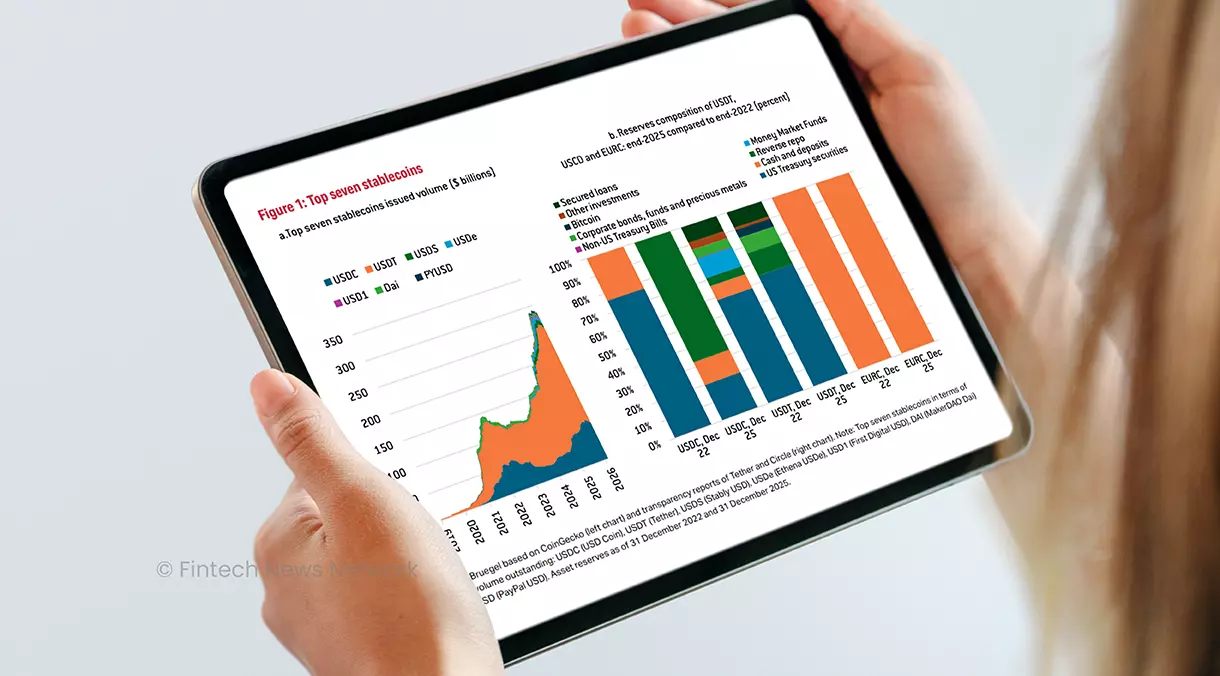
Stablecoins emerged in 2014 but really took off starting in 2020. By 2026, the top seven stablecoins had reached a cumulative volume of nearly US$300 billion.

These digital assets are now finding increasing use beyond cryptocurrency trading in more mainstream applications. Since 2023, stablecoin transaction volumes excluding bot-driven transactions have grown at a compound annual rate of 133%, reaching approximately US$28 trillion in 2025.
Similarly, retail-scale transactions below US$250 and excluding bot activity and high-frequency trading increased from around US$500 million in 2019 to US$69.13 billion in 2025, reflecting growing use in smaller-value, consumer and business payments.

Despite surging stablecoin volumes and usage, issuance and transactions remain overwhelmingly USD-based. Euro-denominated stablecoins account for just 0.3% of total supply, with the largest euro-denominated stablecoin, Circle’s EURC, ranking only twentieth.
At the same time, Europe-based stablecoin transactions made up 38% of global transactions in the final quarter of 2025. This discrepancy implies that the vast majority of crypto-asset transactions associated with Europe are conducted in tokenized USD, rather than the euro.

Featured image: Edited by Fintech News Switzerland, based on image by rawpixel.com via Magnific