



Across major markets, consumers are increasingly spending from their phones, laptops and tablets rather than visiting physical stores, underscoring how habits are shifting towards digital channels.
An analysis of anonymized VisaNet data, the electronic payment network that processes all credit, debit, ATM and digital transactions for Visa, found that between 2019 and 2026, the share of total domestic payment volume conducted remotely, including online and in-app payments, increased in all key countries.
These increases ranged from as high as a 20-point jump in the United Arab Emirates (UAE), where remote payments grew from 35% in 2019 to 55% in 2026, to a 3-point rise in Australia, moving from 41% to 44% over the same span.

In Europe, Poland recorded the largest change among the markets assessed, with remote payments climbing from a share of 10% of total domestic payment volume in 2019 to 24% in 2026. The UK saw a smaller increase because online and in-app use was already high, with remote payments rising from 52% in 2019 to 55% in 2026.

Online transactions increases in frequency
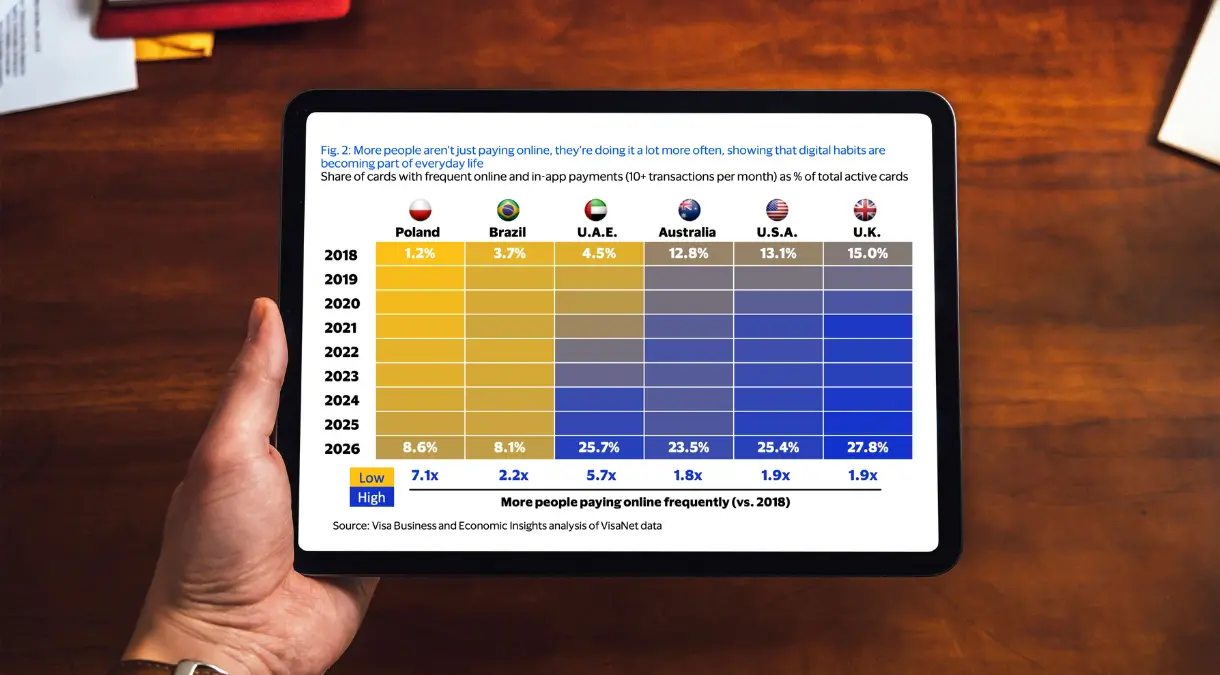
VisaNet data also revealed that the shift to online channels extends well beyond occasional online purchases. Examining the share of cards making frequent online and in-app payments, the data showed a marked rise since 2018 across all the countries studied.
Across these markets, Poland recorded the strongest growth, surging more than sevenfold from a relatively low base. In 2026, 8.6% of cards made 10 or more online or in-app purchases per month, up from 1.2% in 2018. In the UK, nearly 28% of cards reached that same level, up from 15% in 2018. The UAE also saw significant growth, with this share climbing from 4.5% in 2018 to 25.7% in 2026.
These gains reflect how deeply digital behaviors have become embedded into everyday life, becoming the foundation for home-centered routines.

The rise of the “couch economy”
These findings align with what Visa refers to as the “couch economy” and the move toward home-centered living. Right alongside shopping, entertainment has also shifted into the home, with subscription-based entertainment firmly establishing itself as a mainstream household spending category while cinema and concert spending witness a sharp decline.
Ever since the pandemic, the share of cards with streaming and pay-TV subscriptions has exceeded cinema and concert spending in every market examined. This gap is particularly pronounced in the US, where more than 17% of cards have active subscriptions compared to roughly 6% engaging in cinema and concert spending.
Similar patterns can be observed in the UK and Poland, where about 16% and 15% of cards have subscriptions, compared to roughly 7.5% and 5% for cinema and concert spending.

Food delivery app trends also reflect the rise of the couch economy. Anonymized VisaNet data suggest steady food delivery adoption over the past decade, which rose from about 5% in the UK and nearly non-existent in Poland in 2018, to about 15% and 6% in 2026.
Globally, the UAE recorded the largest rise, with the share of cards active on food delivery apps surging from just 2% in 2018 to nearly 30% in 2026.
These results suggest that food delivery has evolved beyond an occasional convenience for a niche group of consumers and become a mainstream service embedded in everyday spending habits.

E-commerce in Europe
In Europe, e-commerce has reached mainstream adoption. Over 1 million businesses in the European Union (EU) now sell goods or digital services via online platforms, and 78% of EU Internet users purchased online in 2025, marking a 16-point increase from 2015, according to the European Commission. Switzerland showed higher activity, with about 82% of Internet users buying online in 2025.

The growth of e-commerce in Europe is driving demand for a digital euro. As trade shifts online, physical cash is losing relevance for more transactions, and a digital euro would provide a more suitable form of central bank money in the digital space.
E-commerce also exposes Europe’s dependence on non-European private payment networks. Nearly two-thirds of euro area card-based transactions are processed by non-European companies, while 13 euro area countries depend entirely on international card schemes or mobile solutions for in-store payments, according to the European Central Bank (ECB).
The EU is currently working on a central bank digital currency (CBDC) that would act as an equivalent to cash, and a complement to banknotes and coins.
Earlier this month, the ECB opened a call specifically for e-commerce and mobile commerce merchants to participate in a digital euro pilot planned to begin in H2 2027, which will test the beta version in realistic e-commerce and mobile commerce environments.
This announcement was followed this week by the launch of a new service by the ECB called Pontes. Pontes allows wholesale tokenized asset transactions to be settled in central bank money. A number of market participants and distributed ledger technology (DLT) operators, including Deutsche Bank, Société Générale, and Clearstream, have already completed onboarding.
Featured image: Edited by Fintech News Switzerland, based on image by 21studio via Magnific