



While artificial intelligence (AI) agents offer substantial potential for commerce, they also carry risks.
To ensure an agentic commerce ecosystem that functions safely, effectively and efficiently for all participants, the industry should adopt the shared principles of transparency, safety, privacy and data, choice, and interoperability, according to a new paper co-authored by ASB Bank, Bank of America, Capital One, Commonwealth Bank of Australia, ING Group and NatWest Group.
The paper, released in September 2026, outlines how these principles can support trust and scale in agentic commerce. By applying these principles, consumers may gain more transparency, safety, choice, and control over data and transactions, while merchants can grow through trusted, interoperable channels that foster innovation.

AI agent providers, technology platforms, and payment schemes and service providers, meanwhile, can use the principles to design services that build trust and encourage sustainable adoption, while industry bodies and regulators can apply them to inform discussions on governance, consumer protection, and market development.
Transparency
According to the paper, agentic commerce introduces new market participants, process flows and incentives. Risks can occur if agents are not clearly identifiable to all parties involved in agentic commerce transactions, and conflicts of interest may arise that require careful consideration. All these risks demand AI agents to be transparent with the consumers and merchants they serve and other agentic commerce service providers they interact with.
To support transparency in agentic commerce, the report argues that all agents should be aware when an AI agent is helping to make or facilitate a transaction, and on whose behalf they are acting. Both consumers and merchants should also know exactly how AI agents prioritize options and make decisions, and how their data is collected and used.
Safety
AI agents should also ensure safety so consumers and merchants can transact safely in agentic commerce, supported by a value chain that coordinates to manage and reduce risk.
Agentic commerce introduces new safety risks, such as higher rates of scams, fraud and disputes. In particular, consumers, AI agents, and merchants may hold mismatched expectations about which product, when and how, or who bears liability if an agent exceeds its authority.
Furthermore, some providers may engage in unsafe practices, like prioritizing payment methods with lower protections, while malicious actors could exploit new attack vectors for scams and fraud, including compromising or impersonating AI agents and merchants.
To prevent these issues, agentic commerce service providers should meet appropriate security and safety standards over the lifecycle of their operations, and use secure, auditable methods to enter payment credentials and authorize purchase intents and payments. They should also collaborate to prevent, detect, disrupt and respond to safety risks.
Meanwhile, consumers should retain appropriate control over the authority they grant to AI agents, including the ability to view and manage delegations.
Privacy and data
Agentic commerce will generate new data, including conversational prompts, decision logs, intent mandates and purchase details. While the richness of such data provides opportunities to enhance customer experiences, there are also potential risks that require careful management. A key risk is privacy for consumers and merchants, including improper collection, misuse, poor quality, breaches, and over-retention.
Against this backdrop, AI agents should prioritize privacy and data, allowing consumers and merchants to use consent to determine how agentic commerce data is created, preserved, accessed and used.
To support this, providers should meet appropriate privacy, data and cyber security standards over the lifecycle of their operations, maintain auditable records to evidence consumer instructions, authentication, intent, and transaction decisions and outcomes, and only access the data they require to deliver their functions safely and effectively. Consumer and merchant consent should also determine any additional use or sharing of their data.
Choice
Agentic commerce will bring new participants into the commerce value chain and new market structures, including devices, agents, marketplaces, digital wallets, and payment networks. This may introduce potential risks to consumer and merchant choice, including access restrictions, or limits on AI agents access to platforms. It may also impose requirements to use specific platforms or affiliated services, creating structures that hinder access to alternative services.
Consumers and merchants should have options, and be able to choose which agentic commerce services they use, without unreasonable restrictions. To support this, the identity and role of the merchants of record should be clear and consumers should have the option to share their identity with merchants if they choose. Service providers should also retain choice over which agentic commerce services they support based on safety, commercial sustainability and legal grounds.
Interoperability
Finally, agentic commerce will introduce different market participants and services. Fragmentation across different AI agents, payment methods or protocols may reduce network effects, increase integration costs, and create challenges with switching.
Hence, AI agents should be developed with interoperability in mind, allowing consumers and merchants to benefit from connectivity across the agentic commerce ecosystem.
To support this, industry stakeholders should focus on building safe and sustainable connectivity for core functions, while providing flexibility for innovation on value added services and features. Overtime, the industry should consider expanding interoperability and connectivity to additional areas where common approaches deliver benefits for consumers and merchants.
The rise of agentic commerce
Agentic commerce refers to an approach to online shopping where AI agents research, compare, negotiate, and complete purchases on behalf of consumers or businesses with little to no direct human intervention. Although the concept is still emerging and in early development, industry participants are building protocols and systems so AI agents can manage product discovery, decision-making, and transactions securely.
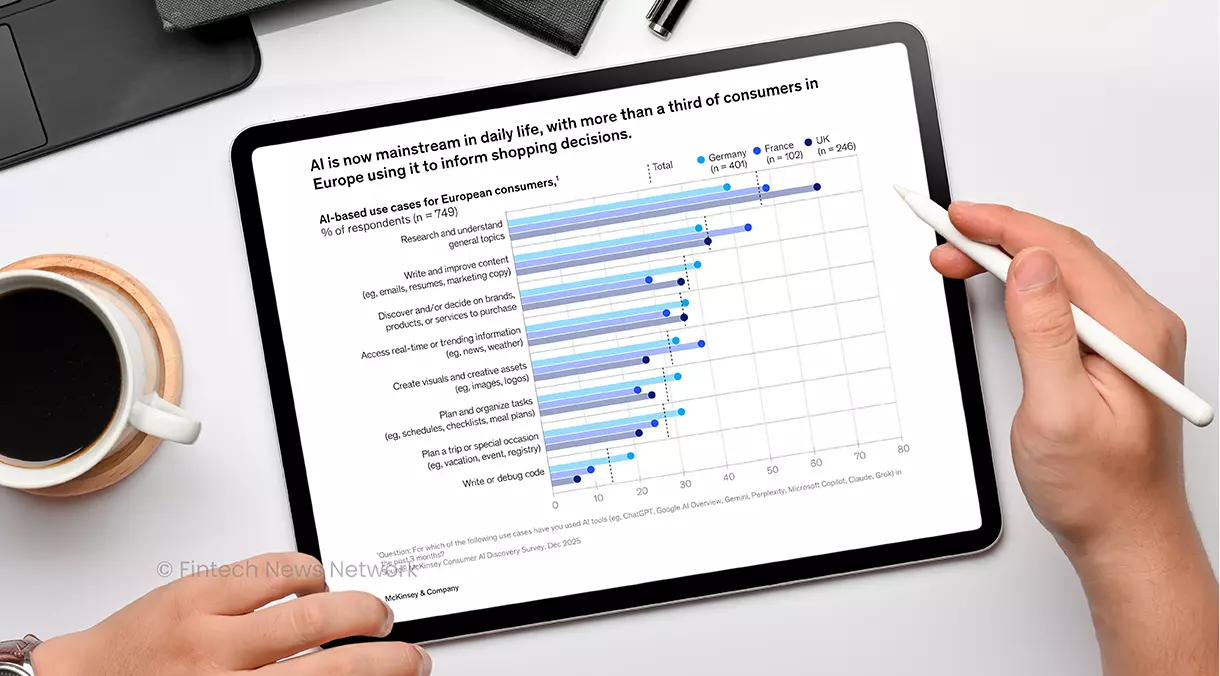
McKinsey research estimates that by 2030, agentic commerce could orchestrate US$3 trillion to US$5 trillion of the global business-to-consumer retail market, building on rising adoption of AI. In Europe, a 2025 consumer survey across France, Germany and the UK found that 84% used AI tools in everyday life, with 38% reporting utilizing the technology to research products and services or deciding what to purchase.

Across the shopping journey, European consumers primarily use AI upstream of the transactions. 63% reported using AI to compare brands, models, prices and review, 55% for learning about a category or product, and 46% for discovering new products and getting inspired.

Featured image: Edited by Fintech News Switzerland, based on image by thanyakij-12 via Magnific