



Europe is emerging as a significant hub for artificial intelligence (AI) applications despite trailing global peers in overall AI investment.
This development is driven by robust research capabilities, a substantial talent pool, and established corporations aiming to remain competitive through domain-specific innovation, according to a new report by McKinsey and Boardwave.
The report, based on quantitative analysis conducted from June to August 2026 and qualitative expert interviews, examines the current state of AI in Europe and highlights a shortfall in overall venture capital (VC). Between January 2025 and June 2026, Europe captured only 10% of the EUR 835 billion raised globally, compared with 71% in North America and 16% in Asia.

In the concentrated foundational layer of platforms and infrastructure in particular, European funding represents just 4% of US levels. Capital is largely consolidated around leading US frontier labs, with the top three players in this space, namely Anthropic, OpenAI, and xAI, raising EUR 229 billion in H1 2026, receiving 85% of US AI platform and infrastructure funding.
A hub for AI applications
While lagging behind the US in the AI infrastructure and foundational layer, Europe is developing into a global leader in the application layer.
The region’s AI startups are increasingly targeting this segment of the AI tech stack, building specialized software that can understand specific workflows, operate inside existing enterprise systems, and automate tasks in complex environments. These startups are now drawing substantial investor attention.
In 2018, European AI application funding stood at just 11% of US levels. By H1 2026, that level had climbed to 44%, with absolute European AI application funding reaching EUR 6.8 billion. The figure is as much as the total of 2024 and position 2026 to exceed the EUR 8.1 billion raised in all of 2025.

Within this layer, vertical or industry-specific AI is showing marked growth. In H1 2026, European startups developing vertical tools captured 67% of the funding raised by their US peers at EUR 67 billion, up from 9% and EUR 500 million in 2018.
Although these absolute figures remain a fraction of the total global AI funding, the trend suggests a positive structural shift that coincides with the rise of a new cohort of European AI leaders. These leaders, which include names like Helsing, Legora, Lovable, and Wayve, average just five years since founding, and yet already rank among the top 100 European tech companies by valuation.

Security, transport, legal lead vertical AI investment
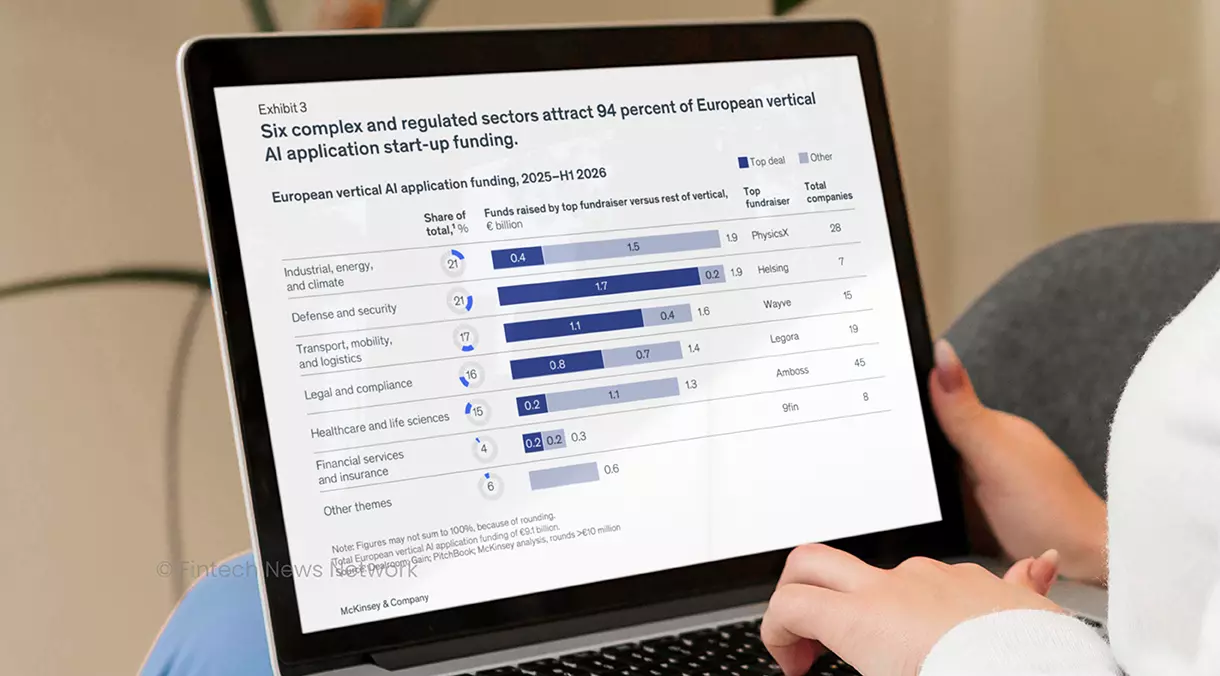
Findings from the McKinsey and Broadwave study show that vertical AI investment in Europe is highly targeted, concentrating in six sectors: industrial, energy, and climate; defense and security; transport, mobility, and logistics; legal and compliance; healthcare and life sciences; and financial services and insurance. This dominance reflects Europe’s established incumbents, linked research ecosystems, and strict regulation.
Top fundraisers in these categories include:
- PhysicsX, a London-based physics AI company for industrials that raised about EUR 400 million in funding in 2025 and H1 2026, equivalent to 21% of all funding raised in the industrial, energy and climate AI vertical;
- Helsing, a defense AI company from France which secured EUR 1.7 billion during the same period, representing to 21% of all defense and security funding;
- Wayve, a UK self-driving startup that raised about EUR 1.1 billion, or 17% of transport, mobility, and logistics funding;
- Legora, a Stockholm collaborative AI platform for lawyers, which secured about EUR 800 million, or 16% of legal and compliance funding;
- Amboss, a media knowledge platform from Germany which raised EUR 240 million in March 2025, or 15% of healthcare and life sciences funding; and
- 9fin, a debt-market intelligence platform from London that raised about EUR 200 million, or 4% of financial services and insurance funding.

Deep talent, research assets, corporates drive AI application innovation
This rise of Europe’s AI application industry stems from several key influences. The region boasts deep talent and research assets, alongside a vibrant corporate ecosystem ready to partner with startups, and supportive governments backing AI progress with substantial resources.
Historically, Europe faced talent attrition with some promising homegrown entrepreneurs relocating their operations or headquartered to the US. However, 2025 saw a net inflow of tech and AI professionals from the US to Europe for the first time in years, according to research by Europe Interface, a European think tank specializing in information technology and public policy. This shift followed policy tools such as visa costs, student routes, and return incentives, which encouraged AI talent migration towards Europe.
Germany now ranks third globally for highly skilled AI talent, behind the US and India. At the same time, the UK maintains its position as a global talent magnet, driven by a dense ecosystem anchored in institutions and research labs like Google DeepMind, the Meta AI London Hub, and Microsoft Research Cambridge, which foster powerful cluster effects.
Furthermore, the historic transatlantic pay gap is narrowing, with leading European AI labs now offering top-tier research and engineering packages in the EUR 300,000 to EUR 500,000 range, putting them closer to US peers, according to McKinsey.
Universities are also emerging as key venture builders. Since 2015, research spinouts have accounted for 33% of new deeptech startups in Europe, with novel AI becoming a major deeptech vertical that captures much of the funding and valuation share, according to a 2026 report by Dealroom, Lake Star and Walden Catalyst.
Europe hosts 30% of the top universities in deeptech subjects, represented by organizations including the University of Oxford, the University of Cambridge, and ETH Zurich.

Another factor behind the rise of European AI leaders is the region’s corporations. Building industry-embedded AI solutions requires access to complex workflows and proprietary data, and European firms are stepping up to help startups gain entree to those assets alongside powerful distribution channels that enable enterprise-grade deployments.
In H1 2026, European AI application VC deal value featuring at least one corporate investor grew to 39% of US levels, rising 25 points from 14% in 2018, according to McKinsey. This trend highlights growing corporate backing in the field.
Government initiatives are supporting these collaborations. The EU AI Champions Initiative, launched in 2025, is a public-private joint effort designed to help accelerate the region’s innovation and competitiveness. Last year, it introduced 18 specific corporate scale-up partnerships, including collaborations involving Allianz with Parloa, and Deutsche Telekom with PhysicsX, unlocking EUR 1 billion in co-investments.
Featured image: Edited by Fintech News Switzerland, based on image by magnific via Magnific