


Close Menu
    • Top Fintech Startups in Switzerland
    • Switzerland Fintech Startup List
    • Virtual Banking
    • Open Banking
    • Online Mortgage
    • Regtech
    • Fintech Events
    • Submit Press Release
    • Submit Startup
    Facebook LinkedIn X (Twitter) Instagram RSS
    • About Fintech News Network
    • Media Kit
    • Contact Us
    • Work With Us
    • Newsletter
    • Submit Press Release
    • Submit Startup
    • Impressum
    Fintech Schweiz Digital Finance News – FintechNewsCH
    part of Fintech News Network

    Fintech News Network

    Facebook LinkedIn X (Twitter) Instagram RSS
    Free Newsletter
    • Blockchain
    • Wealthtech
    • Lending
    • Mobile Payments
    • Insurtech
    • PFM
    • AI
    • Funding
    • Various
      1. Germany
      2. London
      3. USA
      4. Austria
      5. Liechtenstein
      6. View All

      BaFin Fines Deutsche Bank €8 Million Over Postbank Migration Issues

      November 13, 2026

      Affirm Acquires Ratepay as Nexi Focuses on Core Activities

      November 10, 2026

      Eurex Clearing to Handle Digital and Traditional Assets Together

      November 4, 2026

      Deutsche Börse Extends Access to DAX 40 Stocks Beyond Xetra Hours

      October 28, 2026

      Griffin Raises US$20M to Add Card and Stablecoin Services

      November 13, 2026

      HSBC UK Launches Stripe-Powered Tap to Pay for Small Businesses

      November 12, 2026

      UBS Job Cuts Hit London as Credit Suisse Integration Enters Final Phase

      November 6, 2026

      Monzo Weighs New Funding at £7.5 Billion Valuation as Buyout Talks Stall

      November 6, 2026

      Anchorage Digital and Visa Add USDPT as a Settlement Option

      November 13, 2026

      Swiss Wealthtech Firm Avaloq Expands Into US Market

      November 11, 2026

      Morgan Stanley Eyes Tokenisation With Vinyl Equity Deal

      November 10, 2026

      Coinbase Secures Final OCC Approval for Its National Trust Company

      November 10, 2026

      Revolut Austria Banking Branch to Launch in 2027 With Local IBANs

      November 5, 2026

      BingX EU Secures MiCA Licence for Crypto Services in Europe

      October 15, 2026

      Bitget Pauses Withdrawals Following US$351.6M Hot Wallet Hack

      September 25, 2026

      Bybit Payments Secures Austria EMI License for European Payment Services

      August 5, 2026

      Swiss and Liechtenstein Banks Resist Core Banking System Overhaul

      November 11, 2026

      Swiss Blockchain Survey 2026: Banks on Stablecoins and Tokenized Funds

      October 20, 2026

      Bank Frick Enables Real-Time Euro Transfers and CHF Payment Receipts

      July 21, 2026

      Celsion Bank Begins Operations, Combining Digital Assets and Traditional Banking

      April 10, 2026

      Top Finfluencers in Switzerland in 2026

      November 10, 2026

      88% of Tech Founders Walk Away with Zero Exit Value

      November 9, 2026

      MUFG Bank Europe Absorbs Securities Arm to Become EU Universal Bank

      November 4, 2026

      Swiss Officials Weigh the Costs of a UBS Relocation Abroad

      October 30, 2026
    • More
      • Fintech Events
      • Top Swiss Fintechs in 2026
      • Swiss Fintech Startup List
      • Accelerators
    Fintech Schweiz Digital Finance News – FintechNewsCH

    Fintech News Network

    Home»AI»Legacy Procurement Frameworks Are Blocking Agentic AI from Scaling
    AI

    Legacy Procurement Frameworks Are Blocking Agentic AI from Scaling

    While still emerging, agentic AI represents a watershed moment for financial services, offering unprecedented opportunities for industry disruption and competitive differentiation.
    Fintechnews SwitzerlandFintechnews SwitzerlandSeptember 29, 20266 Mins Read
    LinkedIn Facebook Twitter Telegram Copy Link Email
    Legacy Procurement Frameworks Are Blocking Agentic AI from Scaling
    Share
    Facebook Twitter LinkedIn Telegram Copy Link Email
    Free Newsletter

    Get the hottest Fintech Switzerland News once a month in your Inbox

    In the financial services industry, agentic artificial intelligence (AI) promises significant benefits across functions and use cases, including front-office personalization, fraud investigation, and back-office processing.

    Yet, several obstacles limit the adoption of AI agents across organizations, keeping most deployments at the proof-of-concept (POC) stage, according to a new report by Inverto, a consultancy specializing in strategic procurement and supply chain management, and a brand of Boston Consulting Group (BCG).

    These issues mostly arise because procurement and governance frameworks are designed for stable, deterministic software. These frameworks cannot accommodate systems that evolve continuously, distribute accountability across vendor layers, and require a level of auditability that standard contracts do not support, oftentimes preventing agentic AI initiatives from scaling.

    Bottomline

    To address these challenges, the Inverto paper examines key hurdles when deploying agentic AI in Europe and outlines recommendations for procurement, technology, risk, and compliance leaders. These steps are designed to help these professionals design sourcing models, contract structures, and governance mechanisms that will allow agentic AI to shift from supervised pilots into supervised production.

    Most common mistakes and challenges to agentic AI implementation

    The first challenge outlined in the Inverto report is that traditional procurement relies on stability, with fixed requirements, predetermined milestones, and predictable outputs. While these assumptions hold for classical IT projects, they fail in the context of agentic AI, causing pilot projects to remain trapped at the PoC stage, budgets to run out before scaling, and governance reviews to fall behind the technology they should monitor.

    Another issue is that agentic AI comprises a range of capabilities used in varied contexts with distinct risk profiles. For example, a customer-facing advisory agent or an anti-money laundering (AML) triage assistant does not carry the same regulatory exposure, accountability demands, or failure modes as a back-office reporting orchestrator.

    Yet, most financial institutions apply identical procurement templates and governance workflows to all AI agents. This leads to misapplied safeguards.

    A further challenge is that agentic AI can generate recommendations, trigger actions, or shape decisions. This shifts how responsibility is distributed across systems and organizations.

    Inverto notes that three areas need clear accountability: who is responsible when an agent’s autonomous output causes harm, who maintains auditability over decisions from a continuously evolving system, and who ensures compliance when multiple vendors contribute components to the same workflow.

    Finally, the last major issue highlighted is that agentic AI needs continuous improvement. This is a challenge because most commercial arrangements are designed for one-off delivery, with fixed scopes, fixed budgets limit, IP restrictions, and terms that rarely reward post-launch improvement. This often results in agentic systems stagnating before they reach the maturity that justifies the investment.

    Procurement: an architect of AI deployment

    In Europe, Inverto notes that scaling agentic AI in financial services requires navigating a complex regulatory landscape. The environment includes the EU AI Act, the Digital Operational Resilience Act (DORA), circulars by Germany’s Federal Financial Supervisory Authority (BaFin), and the European Central Bank (EBC) expectations.

    These constraints reshape procurement, requiring coordination among sourcing models, governance mechanisms, contractual controls, and supplier relationships so that innovation advances with full regulatory alignment without creating a compliance bottleneck.

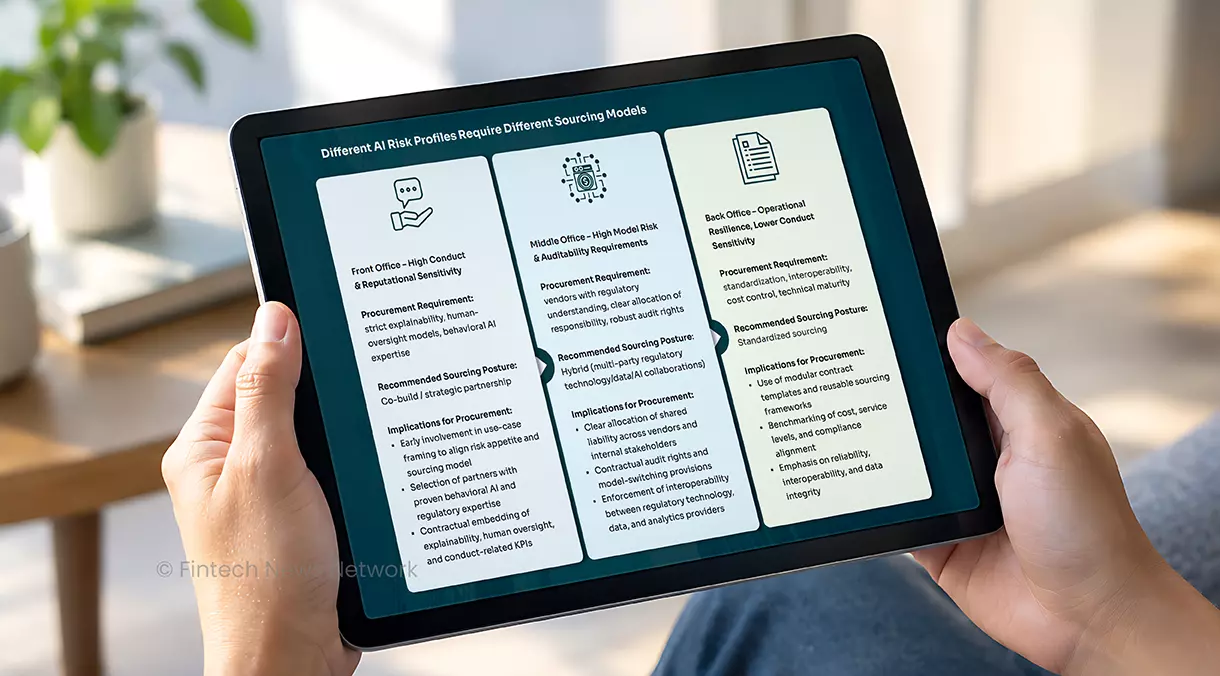
    To achieve this, the report highlights five key pillars. First, procurement should adopt a targeted sourcing strategy. This strategy should align with business impact and risk based on the specific applications and use cases selected beforehand.

    Different AI risk profiles require different sourcing models, Source: Scaling Agentic AI in Financial Services: Procurement as a strategic enabler, Inverto, 2026
    Different AI risk profiles require different sourcing models, Source: Scaling Agentic AI in Financial Services: Procurement as a strategic enabler, Inverto, 2026

    Second, financial institutions cannot rely on traditional linear procurement processes for technologies that evolve continuously like agentic AI. At the same time, uncontrolled experimentation is incompatible with supervisory expectations.

    Adaptive procurement addresses this issue by reframing PoCs as the first governed step in a structured scaling model. When embedded in a phased approach with clear decision gates, accountability, and outcome criteria, PoCs become a controlled mechanism for learning and a deliberate gateway to industrialization, Inverto says.

    An adaptive procurement model featuring three stages, Source: Scaling Agentic AI in Financial Services: Procurement as a strategic enabler, Inverto, 2026
    An adaptive procurement model featuring three stages, Source: Scaling Agentic AI in Financial Services: Procurement as a strategic enabler, Inverto, 2026

    Another key recommendation involves clearly translating regulatory expectations into contractual structures before negotiations begin.

    In an AI-driven landscape, contracts function as both commercial instruments and governance mechanisms. Supervisory bodies expect financial institutions to demonstrate who is responsible for system outputs, how decisions can be traced, and how systems are monitored over time.

    Hence, procurement should define enforceable stances on data usage, audit rights, and responsibility before entering negotiations.

    Another recommendation from Inverto involves turning innovation into a repeatable capability. Supervisors increasingly expect evidence of control, leading institutions relying on bespoke processes for each use case to risk inconsistency, delays, and regulatory exposure.

    Procurement can solve this by developing a standardized AI procurement control framework that provides a reusable and auditable system of templates, tools, and governance artifacts. Standardization codifies good practice, accelerates adoption, and ensures that innovation is consistently implemented within a mature control environment.

    Finally, the last recommendation is to build an agentic AI supplier ecosystem. Most financial institutions already work with a mix of large technology providers and specialized niche vendors. In most cases, these relationships are managed independently by different functions, governed through inconsistent contracts, and optimized for individual use cases rather than system-wide accountability.

    Agentic AI changes this dynamic. Because autonomous systems increasingly span multiple vendors, models, and decision layers, the supplier landscape itself becomes a source of risk if it is not deliberately structured.

    In this context, the role of procurement is shifting from managing individual vendor relationships to actively designing and governing an ecosystem. They must ensure that stability, innovation, accountability, and regulatory compliance are aligned across all contributors.

    While still emerging, agentic AI represents a watershed moment for financial services, offering unprecedented opportunities for industry disruption and competitive differentiation. In wealth management, Deloitte Center for Financial Services predicts that AI, especially agentic execution, has the potential to uplift advisor productivity by roughly 30% to 100% by 2032.

    At an industry level, that implies that between 25% and 50% of advisor time could be freed from lower-value operational work. In terms of assets under management (AUM), that uplift could expand industry capacity by the equivalent of US$10 trillion to US$35 trillion in additional client assets.


    Featured image: Edited by Fintech News Switzerland, based on image by Sketch Graphic via Magnific

    Sponsored ReportThe Payments Intelligence GapRead
    agentic AI financial services procurement
    Share. Facebook LinkedIn Twitter Telegram Copy Link Email

    Author

    fintech switzerland
    Fintechnews Switzerland
    • Facebook
    • X (Twitter)

    Related Posts

    Former Swiss Life CEO Bruno Pfister Joins Selma as Strategic Adviser

    November 12, 2026

    Keith Fenner Succeeds Asger Hattel as Signicat CEO

    November 11, 2026

    Light Frame Raises US$5.1M to Upgrade Core Systems at Private Banks

    November 11, 2026

    Despite Broad AI Adoption in Investment Management, Applications Remains Narrow

    November 11, 2026

    UBS Grows Live AI Use Cases to 608 as Staff Run 12,700 Agents

    November 2, 2026

    Checkout.com Begins Rolling Out Visa Payment Passkey to Merchants

    October 30, 2026

    Alibaba Cloud Launches New Cloud Region in Amsterdam

    October 30, 2026

    CTO Craft Con: Fintech Brings Tech Leaders to London This November

    October 29, 2026
    AI Sponsored

    81% of Financial Firms Use AI. Only 14% Call It Transformational

    October 21, 2026
    Fintech Newsletter
    Subscribe to the most important Fintech Switzerland News
    Follow Us
    • Facebook
    • X / Twitter
    • LinkedIn
    • Instagram
    Swiss Fintech Startup Directory

    Swiss Fintech Startup Directory

    Top Swiss Fintech Startups

    Top Fintech Startups in Switzerland for 2026

    Upcoming Fintech Events
    Country
    AI & Big Data Expo Global 2027
    February 3, 2027
    -
    February 4, 2027
    United Kingdom
    -
    London
    Digital Finance Summit 2026
    December 3, 2026
    Belgium
    -
    Brussels
    Digital Society 2026
    November 25, 2026
    Germany
    -
    Frankfurt am Main
    EURO FINANCE Tech Day 2026
    November 18, 2026
    Germany
    -
    Frankfurt
    European Digital Finance Conference 2026
    November 19, 2026
    Netherlands
    -
    Amsterdam
    Promote Event View More
    Whitepapers & E-Books
    The Future of Competitive Advantage in Banking & Payments
    The Future of Competitive Advantage in Banking & Payments
    Bottomline
    American Newsletter

    Fintech News America

    Australia Fintech Map

    Australia Fintech Map

    Philippines Fintech Report

    SINGAPORE FINTECH REPORT

    Singapore Fintech Map 2025

    Indonesia Fintech Report

    Indonesia Fintech Map 2025 banner

    UAE Fintech Report

    UAE Fintech Report 2024

    Free Business Accounts

    Navigation
    • About Fintech News Network
    • FNN Media Kit
    • Work With Us
    • Contact Us
    • Fintech Switzerland Newsletter
    • Submit Press Release
    • Submit Fintech Startup
    • Datenschutzerklärung / Impressum
    Other Fintech News Network Publications
    Fintech News Switzerland
    Fintech News Singapore
    Fintech News Malaysia
    Fintech News Hong Kong
    Fintech News Philippines
    Fintech News Network Indonesia
    Fintech News Network Australia
    Fintech News Baltic
    Fintech News Nordics
    Fintech News America
    Fintech News UAE
    Fintech News Africa
    Get Informed

    Subscribe to Updates

    Subscribe to the most important Fintech Switzerland News

    Facebook LinkedIn X (Twitter) Instagram RSS
    • About Fintech News Network
    • FNN Media Kit
    • Work With Us
    • Contact Us
    • Fintech Switzerland Newsletter
    • Submit Press Release
    • Submit Fintech Startup
    • Datenschutzerklärung / Impressum
    © 2015 - 2026 Copyright CK Finanzpro GmbH. All Rights reserved.

    Type above and press Enter to search. Press Esc to cancel.

    Fintech Schweiz Digital Finance News - FintechNewsCH
    Manage Consent

    Your Privacy Matters to Us

    To provide the best experiences, we use technologies like cookies to store and/or access device information. Consenting to these technologies will allow us to process data such as browsing behavior or unique IDs on this site. Not consenting or withdrawing consent, may adversely affect certain features and functions.

    Functional Always active
    The technical storage or access is strictly necessary for the legitimate purpose of enabling the use of a specific service explicitly requested by the subscriber or user, or for the sole purpose of carrying out the transmission of a communication over an electronic communications network.
    Preferences
    The technical storage or access is necessary for the legitimate purpose of storing preferences that are not requested by the subscriber or user.
    Statistics
    The technical storage or access that is used exclusively for statistical purposes. The technical storage or access that is used exclusively for anonymous statistical purposes. Without a subpoena, voluntary compliance on the part of your Internet Service Provider, or additional records from a third party, information stored or retrieved for this purpose alone cannot usually be used to identify you.
    Marketing
    The technical storage or access is required to create user profiles to send advertising, or to track the user on a website or across several websites for similar marketing purposes.
    • Manage options
    • Manage services
    • Manage {vendor_count} vendors
    • Read more about these purposes
    View preferences
    • {title}
    • {title}
    • {title}