



Although robotaxis remain in an early phase with limited use across Europe, German riders who have tested these autonomous vehicles (AVs) are reporting a positive experience and willingness to travel again, especially when costs are attractive, according to a new report by the University of St. Gallen’s Institute for Mobility in partnership with Israeli autonomous driving company Mobileye.
The report draws on the perspectives of thought leaders and a Germany-wide consumer survey to explore the rationale behind launching robotaxis in Europe, assess core market elements, the state of the industry, and user perceptions and intentions.
Conducted with Uranos, the survey polled more than 2,500 people in Germany during February and March 2026. It found that although two-thirds of respondents were familiar with the concept of robotaxis, only 2% had used them, reflecting the lack of established robotaxi services in Europe compared to markets like the US or China.

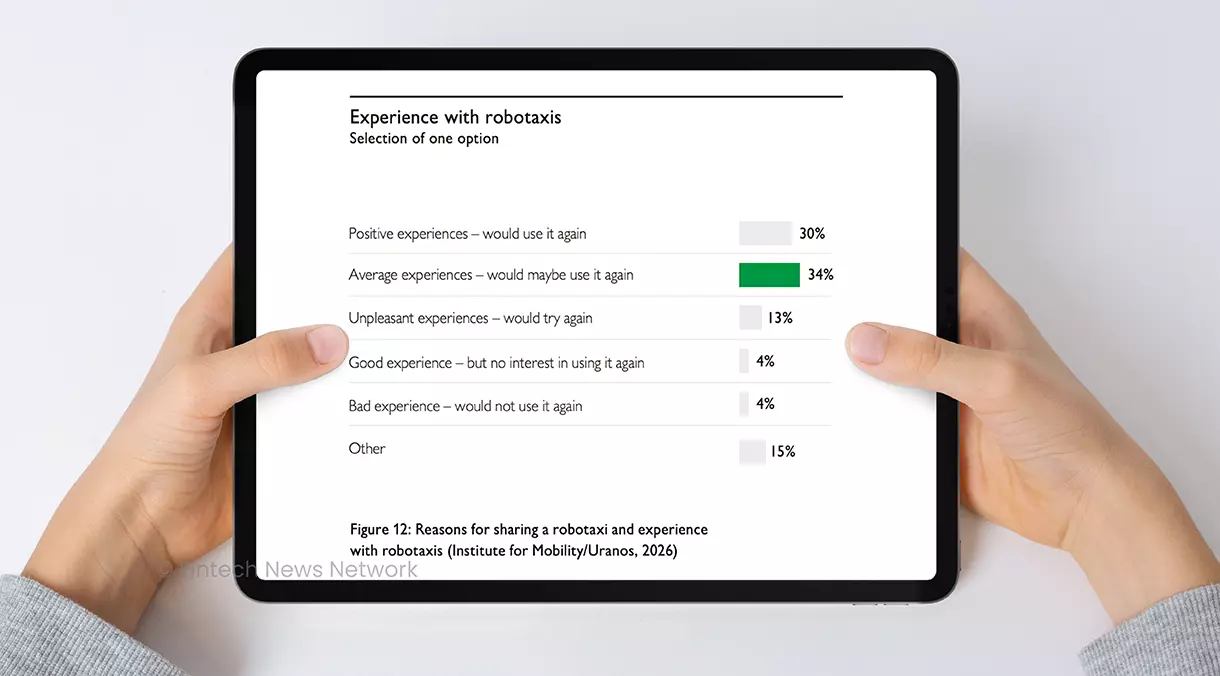
Even with an emerging market, those who have ridden these AVs reported positive outcomes, suggesting growing openness to the technology. About 30% noted positive experiences and would use a robotaxi again, while 34% described an average experience and might consider it.

Most current robotaxis offer private rides, but some take on additional passengers and can resemble shared autonomous shuttles. For these models, cost is the leading factor in usage intent, with 49% of respondents stating that they would consider the option if it reduced expenses.
Respondents also emphasized that sharing should not cause time loss (38%) and that they should know their fellow passengers in advance (17%).

Safety and costs as the biggest concerns
Despite a generally favorable view of robotaxis, 29% of respondents said they were familiar with robotaxis but were not interested in using them. Among those uninterested, most said they lacked a specific reason, with 42% feeling content with current mobility and seeing no need for a robotaxi.
Safety concerns also play a key role, with 34% citing worries about autonomous driving as their reason for avoiding robotaxis.
Although manufacturers have claimed self-driving cars will cut accidents, notable events have occurred, with news reports describing AVs hitting barriers, swerving into traffic, running red lights, and entering police standoffs.
While these issues occur relatively infrequently, some experts are concerned that they will become more pronounced as the technology spreads.
Currently, Tesla’s self-driving taxis are facing a US safety review over claims that the robotaxis speed through school zones. A petition says that the cars exceeded posted limits in active zones while automated driving systems were engaged, Business Insider reported earlier this week. It involves 2026 model year Robotaxi, Model Y and Cybercab vehicles, totaling an estimated 1,000 vehicles in total.
In January, a vehicle of Waymo, a subsidiary of Alphabet, struck a child near an elementary school in Santa Monica, California. The National Highway Traffic Safety Administration (NHTSA) said the child ran into the street from behind a double-parked SUV and was hit by the AV.

Beyond safety issues, German respondents identified the perceived cost of a robotaxi trip as a major concern.
Robotaxi operators have been working on lowering their prices. Rideshare comparison app Obi conducted a research in the Bay Area and found that in June 2025, Waymo rides were priced 30-40% higher than Uber and Lyft. By January 2026, that gap had narrowed to an average of 12.7% more expensive than an Uber and 27.3% more expensive than a Lyft. For rides between 4.3 and 9.3 kilometers, Waymo is now only 2% more expensive than Uber and 17% more expensive than Lyft per kilometer.
Tesla is the undeniable leader in the field. Obi’s data shows that the price for a Tesla robotaxi ride in San Francisco rarely exceeds US$10, averaging US$8.17 versus the next cheapest option, Lyft, which averages US$15.47. That’s a staggering US$7.30 average price variance.
Market outlook
Autonomous driving is on the rise globally. In Europe, well over 100 AV pilot projects have been initiated, and several have shown success while shifting toward broader services.
For example, MOIA, a ride-pooling provider from Germany that is part of the Volkswagen Group, has entered pre-series production of its robotaxis and roboshuttles and has announced expansion plans from Hamburg to Berlin, Oslo, and Los Angeles.
Meanwhile, automakers Mercedes-Benz and Stellantis are investing in promising partnerships with robotaxi and tech companies to bring self-driving vehicles to Europe.
Adoption in the US and China has progressed more rapidly. In March 2026, Waymo recorded over 500,000 paid rides per week across ten cities. The company is now looking to expand globally, having registered European corporate entities in Germany, France, the Netherlands, Spain and the UK.
Meanwhile, its Chinese counterpart Pony.ai is on the verge of large-scale commercialization in its home market. In Guangzhou and Shenzhen, the company has aleady achieved per-vehicle, or unit economics (UE).
Industry insiders are calling 2026 the year of the robotaxi expansion, with the number of robotaxis operating globally expected to more than double by the end of the year from about 8,000 in December 2025 to 18,000.

In Europe, Germany is one of the developed markets for AVs, supported by pioneering regulations.
The Autonomous Vehicles Approval and Operation Ordinance (AFGBV), which took effect in 2022, establishes a legal framework that enables the operation of Level 3 and Level 4 vehicles.
At these levels of automation, control lies primarily or exclusively with the vehicle, and humans take over driving tasks only if necessary. This allows human drivers to take their hands, eyes, or even their attention off the road, either temporarily or permanently.
Most current passenger cars operate primarily at Levels 1 and 2, where the driver retains control of the vehicle at all times, but where the vehicle assists in specific situations, such as lane-keeping assistance on highways or adaptive cruise control in traffic jams.

Featured image: Edited by Fintech News Switzerland, based on image by RSplaneta via Magnific