



In 2026, agentic artificial intelligence (AI) systems will transform how individuals and organizations operate, converting employees into human supervisors of AI agents, helping security teams handle alert triage and threat investigation more efficiently, and enhancing customer experiences with personalized concierge-style services, according to a new whitepaper by Google Cloud.
At the same time, the rise of AI agents will also require organizations to invest in workforce upskilling, including internal innovation programs, and comprehensive training on AI risks and data governance.
The whitepaper draws on qualitative and quantitative data, including internal Google Cloud and Google DeepMind interviews with AI leaders, customer case studies and insights from studies. It highlights five critical shifts in business driven by AI agents in 2026.

Boosting productivity
In 2026, agentic models will expand the potential of individuals, turning them into the primary engine for innovation and growth.
AI agents will manage complex, multi-step workflows across systems, while employees will be responsible for setting the strategy and overseeing the system responsible for tasks, such as invoicing and contracts.
In this new paradigm, every employee will become a human supervisor of agents. Their new responsibilities will be to delegate mundane or repetitive tasks, set goals and desired outcome for the agent, and outline strategy.
For example, in marketing, managers could orchestrate systems of specialized AI agents to achieve their goals, rather than performing every task personally. A typical setup will involve five specialized agents working in concert. The data agent will sift structured and unstructured data points to find patterns in market trends. The analyst agent will monitor market trends, competitors’ announcements, and social media sentiment. The content agent will draft copies for social media posts and blog articles. The creative agent will generate images and videos to accompany those social posts. Finally, the reporting agent will connect to the company’s analytics platforms to pull and analyze weekly campaign data and deliver summaries.
Running businesses
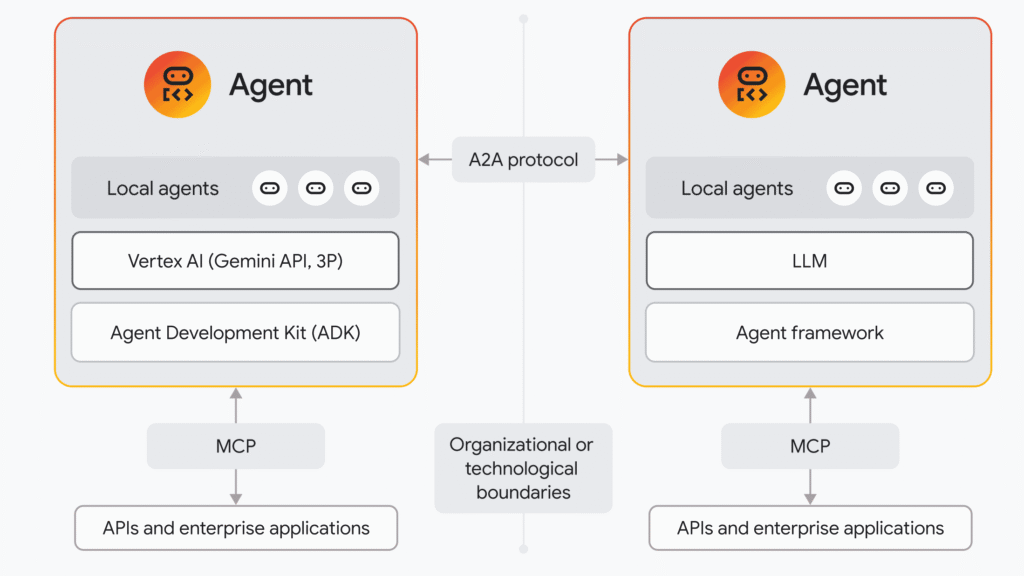
Agentic systems will orchestrate multiple agents to make the entire businesses run more intelligently, efficiently, 24/7, and at scale.
Agentic workflows will bridge previously siloed functions, such as network operations, field services, and customer contact centers in telecommunications. In this integrated environment, agents will autonomously remediate network anomalies, proactively open a ticket with the field service systems, and alert contact centers to inform customers of a technician dispatch, all within a single sequence.
For example, an AI agent from a media company could connect to a retailer’s agent to showcase the details and pricing on a specific product displayed in streamed or broadcast content. Similarly, AI agents at a hospital could work directly with labs or insurance agents, provided the patient grants permission. In e-commerce, AI agents could monitor prices and availability and, with human pre-approval, execute a secure purchase.
Leading the change in this space, PayPal is creating agentic shopping and commerce experiences by adopting the Agent Payments Protocol (AP2), an open standard protocol that enables AI agents to carry out payments on behalf of users, and enabling checkout within Microsoft’s Copilot.
Salesforce is working with Google Cloud to create AI agents that work across both platforms using the Agent2Agent (A2A) open protocol.
Elanco, a leader in animal health, uses Gemini models within the Elanco.ai platform to automate workflows, retrieve and analyze company data, and execute knowledge tasks across the business.
Concierge-life experiences for customers
Over the past decade, customer service automation involved pre-programmed chatbots answering simple questions and deflecting support tickets. With advances in large language models (LLMs) and A2A, 2026 will deliver more helpful concierge-style agents that connect enterprises and customers by remembering preferences and past conversations to offer truly one-on-one experiences.
A notable example of this trend is Home Depot’s Magic Apron, a suite of generative AI (genAI) tools that helps store associates quickly access product knowledge, answer customer questions, and get guidance on home improvement projects. It combines company data with AI to improve employee productivity and customer service on the sales floor.
In 2026, agentic concierges will monitor systems for triggers and resolve problems using real-time data to provide insights and take actions with human guidance and oversight.
For example, in healthcare, agents could integrate data such as imaging, electronic health record (EHR) systems, and claims, to deliver proactive insights directly into the clinician’s workflow. This would enable preemptive risk management across patient populations and democratize high-quality healthcare.
Advancing security
With their ability to reason, act, observe, and adjust actions based on new information, AI agents will help security teams identify and respond to threats more effectively. In 2026, AI agents will increasingly assist with tasks like vulnerability discovery, alert triage, and investigation.
Google Cloud’s 2025 ROI of AI study further highlights this trend. Among the 3,400+ executives polled, 46% of the organizations with production-ready AI agents use them for security operations and cybersecurity.

With the addition of agentic systems acting as force multipliers and assume the draining and reactive work of “alert-watching”, human analyst roles will change, and shift to a more strategic level, engaging in activities including threat hunting, supervising and fine-tuning agents, and focusing on long-term security posture like architecting better defenses and anticipating the next wave of attacks.
This comes as IT and cybersecurity leaders face increasing alert and data overload. A 2025 Forrester survey of more than 1,500 senior leaders at enterprise organizations found that 82% of respondents are concerned their organizations are missing real threats due to these volumes, underscoring the challenge of prioritizing and responding to potential threats effectively.
Upskilling talent
As AI evolves, the skills gap is widening, especially as the scope of employee work shifts to include agent management and orchestration. To thrive, organizations will need to build an AI-ready workforce and establish a holistic strategy built on five pillars:
- Setting up clear and measurable goals that align with the bigger picture of what their organization needs;
- Gathering a team of primary stakeholders for their AI initiative, tasked with providing the necessary funding and messaging on AI’s importance; managing grassroots campaigns, generating excitement, and collecting employee ideas; and transforming those prioritized ideas into functional solutions;
- Maintaining momentum through regular multichannel communication and a quarterly awards program to recognize and reward AI use cases, new ideas, and innovators;
- Hosting internal hackathons where small teams compete to develop and pitch innovative AI solutions, and encouraging staff to practice using new custom AI tools and other innovations; and
- Preparing their organizations for increasing risks by training their staff on what data can and cannot be used in AI tools, and teaching them how to recognize sophisticated threats like social engineering that uses AI.
Featured image by Frolopiaton Palm on Freepik