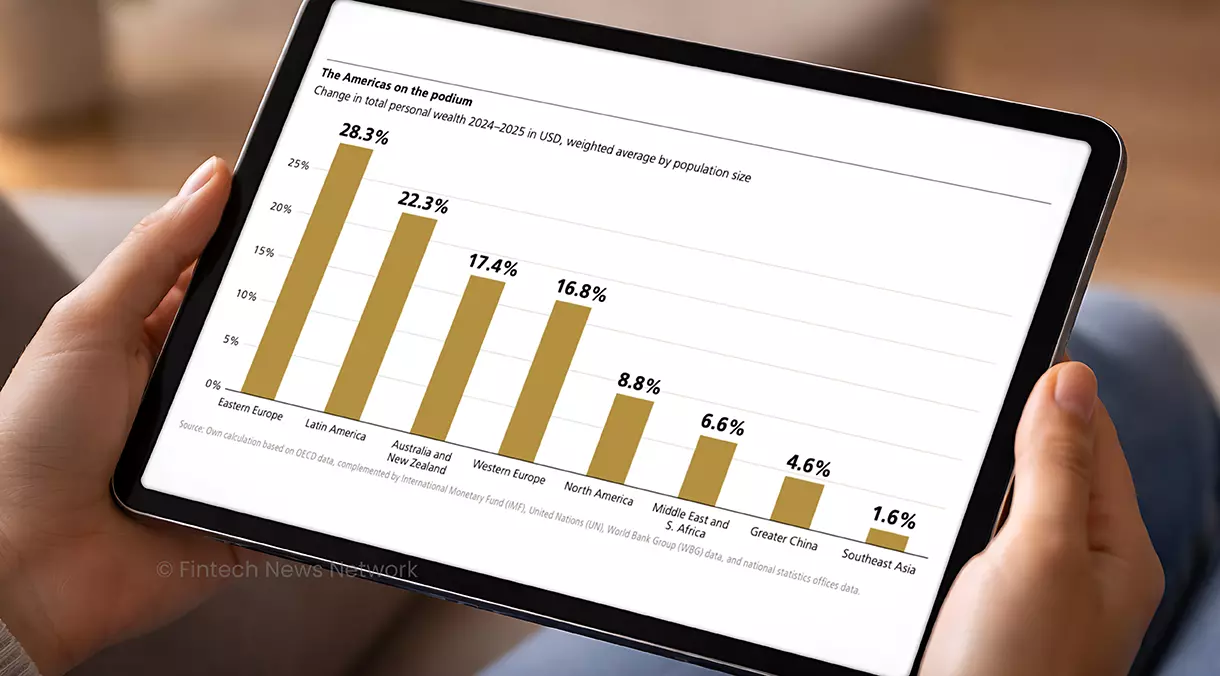




2025 was an extraordinary year for global wealth. According to UBS’s Global Wealth Report 2026, personal wealth rose by 10.8%, the fastest pace in years, with growth being the strongest in Europe, the Middle East and Africa (EMEA) at 17.5%.
This was largely driven by Western Europe, with nearly 17% gain, and Eastern Europe, with an exceptional 28% surge. The Americas followed at 8.5%, while Asia-Pacific (APAC) recorded more modest but still solid growth at 5.9%.

In 2025, the US continued to lead global wealth, and was home to 35.7% of global personal wealth, giving North America a 38.1% share. Western Europe followed with 21.9%. Helped by its large population, Greater China ranked third with 18.5%.


Millionaires worldwide
This wealth growth fueled expansion in the number of millionaires worldwide. In 2025, the number of USD millionaires rose by 1.5%, corresponding to nearly one million new millionaires minted in 2025, or over 2,680 per day.
The highest growth rates in USD millionaires were concentrated in Eastern Europe, led by Lithuania with an 8% increase year‑on‑year (YoY) and followed by Turkey, Latvia and Hungary, all with a growth rate above 5%.

However, in absolute terms, the US alone accounted for over 440,000 new millionaires in 2025, an increase of 1.9% over 2024, translating to more than 1,200 new millionaires per day. The UK witnessed over 43,000 new USD millionaires, while France, Spain, Japan and India still all saw over 30,000 people added to this cohort.
In 2025, the US maintained its position as the country with the highest number of millionaires overall. Over 40% of the world’s USD millionaires live in the US, amounting to more than 23.6 million people out of the roughly 57.5 million millionaires.
Mainland China followed with more than 5.3 million people, and Japan with 2.9 million. Germany, the UK occupy the fourth and fifth spot in the ranking, with 2.6 million and 2.4 million millionaires, respectively.
Switzerland and India were home to a nearly identical number of USD millionaires, roughly 944,000, slightly below Spain’s cohort.
In total, Western Europe was home to slightly fewer than 15 million USD millionaires, or 25% of the total. A nearly identical number of millionaires resided in APAC.

Technological changes in wealth management
Several trends are shaping the global wealth landscape. Boston Consulting Group (BCG)’s 2026 wealth report identifies artificial intelligence (AI) as a defining catalyst, identifying two possible scenarios.
The displacement scenario envisions AI agents essentially replacing financial advisors by handling portfolio construction, financial planning, tax optimization, and client communication at scale.
Fees would compress structurally, and competitive advantage would shift toward firms with the largest client volumes rather than the deepest relationships. Even at the higher end, a meaningful share of advisory value would be automated over time, and the advisor role, while it survives, would become narrower and more specialized.
A more likely outcome is AI disruption rather than displacement. In this scenario, the AI-first wealth manager would expand capacity across the value chain and reshape the economics of advice without removing its human core. AI would fundamentally enable advisors to scale coverage well beyond traditional limits, allowing a significant increase in clients by automating monitoring, servicing, and large parts of client engagement.
According to BCG research, AI will not affect all parts of wealth management equally. Conversion rates are set to improve by 10-25% through AI-powered lead scoring, smarter targeting and retention, and superior client experience. Capacity potential could unlock by 25-30% across planning, portfolio management, and servicing through AI-enabled personalized financial life planning and broader client coverage.
Finally, revenue per advisor could increase by 15-20% through cross-selling, retention, and shifting advisors to higher-value activities, while structurally lower costs is expected to emerge from compressed planning, portfolio management, and servicing expenses.

Across the wealth management value chain, AI has the potential to automate 45-55% of onboarding and know-your-customer (KYC) processes, and 40-55% of account servicing work.
However, top opportunities currently lie across client acquisition, especially campaign design and execution, prospect discovery and lead scoring, and personalized outreach, as well as portfolio management, particularly in portfolio construction and implementation, trade impact simulations, and advisory investment proposals.

Featured image: Edited by Fintech News Switzerland, based on image by Sketch Graphic via Magnific