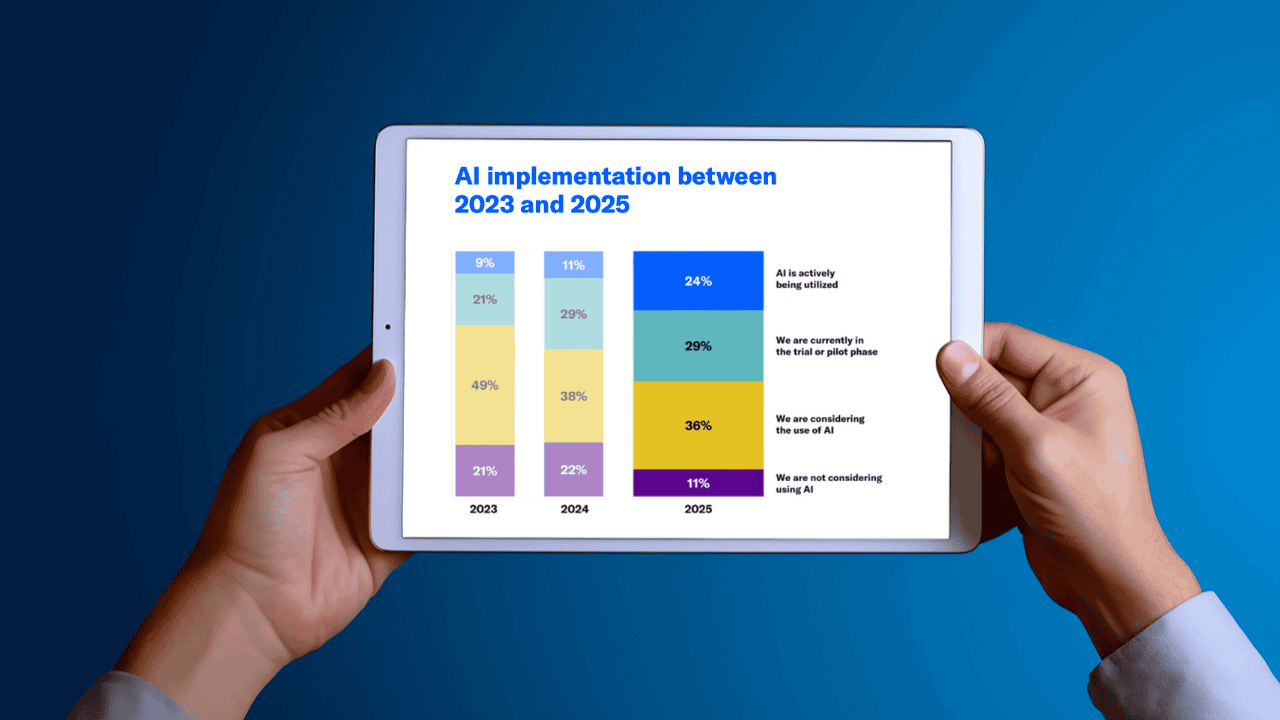




Artificial intelligence (AI) is being rapidly adopted across risk and compliance functions to improve fraud detection, streamline customer due diligence, and enhance operational efficiency.
Between 2023 and 2025, the share of organizations using or trialing AI increased by 23 points with fintech companies leading adoption, according to a study commissioned by Moody’s and conducted with We Live Context.
The study, which polled 600 risk and compliance professionals across different regions and sectors to understand, evaluate, and implement AI in risk and compliance, found that 53% of respondents are either utilizing or piloting AI. Of these, 24% of financial services organizations are already using AI, marking a 15-point increase from 2023, and a 13-point increase from 2024.


Fintech leads AI adoption
Fintech firms currently lead AI adoption in risk and compliance, with 74% of respondents either using or trialing the technology. Asset and wealth management firms follow at 73%, and professional services at 60%.
By contrast, adoption is lower among corporates (35%), insurers (45%), and banks (50%). Government respondents also reported lower awareness of AI use in compliance (72%), compared with fintech (99%) and professional services (93%).
Fintech companies are also applying AI more broadly as they innovate. For example, payment firm Stripe uses AI to identify and prevent fraud in real-time; ComplyAdvantage provides AI-driven tools and data to help clients like Santander, Mollie, and Plaid detect and manage financial crime risk; and Jumio offers AI-powered identity verification, electronic know-your-customer (KYC), and fraud and compliance tools to companies including Webull and Scalapay.
Digital transformation, risk management among top areas of AI use
At present, organizations mostly use AI as part of a broader digital transformation strategy (43% use/trial; 52% consideration), automating routine tasks where possible, and augmenting human decision-making where judgment is required. They also use of AI in risk analytics and management (41% use/trial; 45% consideration), data strategy and analytics (40% use/trial; 45% consideration), and data governance (40% use/trial; 46% consideration).

Impact of AI
An overwhelming majority of the people polled (84%) agree or strongly agree that there are significant advantages to using AI, while 93% reported already seeing positive effect.

Streamlining repetitive tasks was cited as the top benefit, named by 23% of respondents as the primary advantage, and by 70% as a key advantage. Accelerating analysis (66%), reducing costs (64%), handling larger volumes of data (56%), and improving accuracy (51%) were all also cited as key advantages for more than half of those surveyed.

Concerns and challenges
Despite these benefits, industry stakeholders expressed concerns about AI adoption. Over-reliance on AI (18%) was identified as their top issue, with fears of losing critical human expertise and judgment. Data privacy (12%) and mistakes stemming from AI (11%) were also frequently cited.
Respondents also shared their biggest challenges to scaling AI, with regulatory concerns (33%), integrating with existing systems (30%), and lack of budget cited among the biggest hurdles that risk and compliance professionals face. But chief among them is a lack of internal expertise or skills, with 41% of respondents seeing this as the primary barrier to adopting AI at scale.

These results align with findings from other studies, which indicate that rapid AI adoption is intensifying the AI skills shortage.
According to the 2025 Nash Squared/Harvey Nash Digital Leadership Report, AI is now the most scarce technology skill, jumping from sixth place just 18 months earlier. This increase marks the steepest and largest jump in any technology skills shortage recorded for over 15 years.
Among 2,000 surveyed digital leaders, 51% reported an AI skills shortage, up from 28% in the previous report, representing an 82% increase over the period.
Featured image: Edited by Fintech News Switzerland, based on image by vector_corp via Freepik