

In Switzerland and Liechtenstein, financial institutions view stablecoins, central bank digital currencies (CBDCs), and tokenized funds as the most significant trends in digital assets and tokenization over the next three to five years, according to a new study by the Center for Financial Services Innovation at the University of St. Gallen.
However, integration and progress remain limited for these offerings due to economic and commercial reasons.
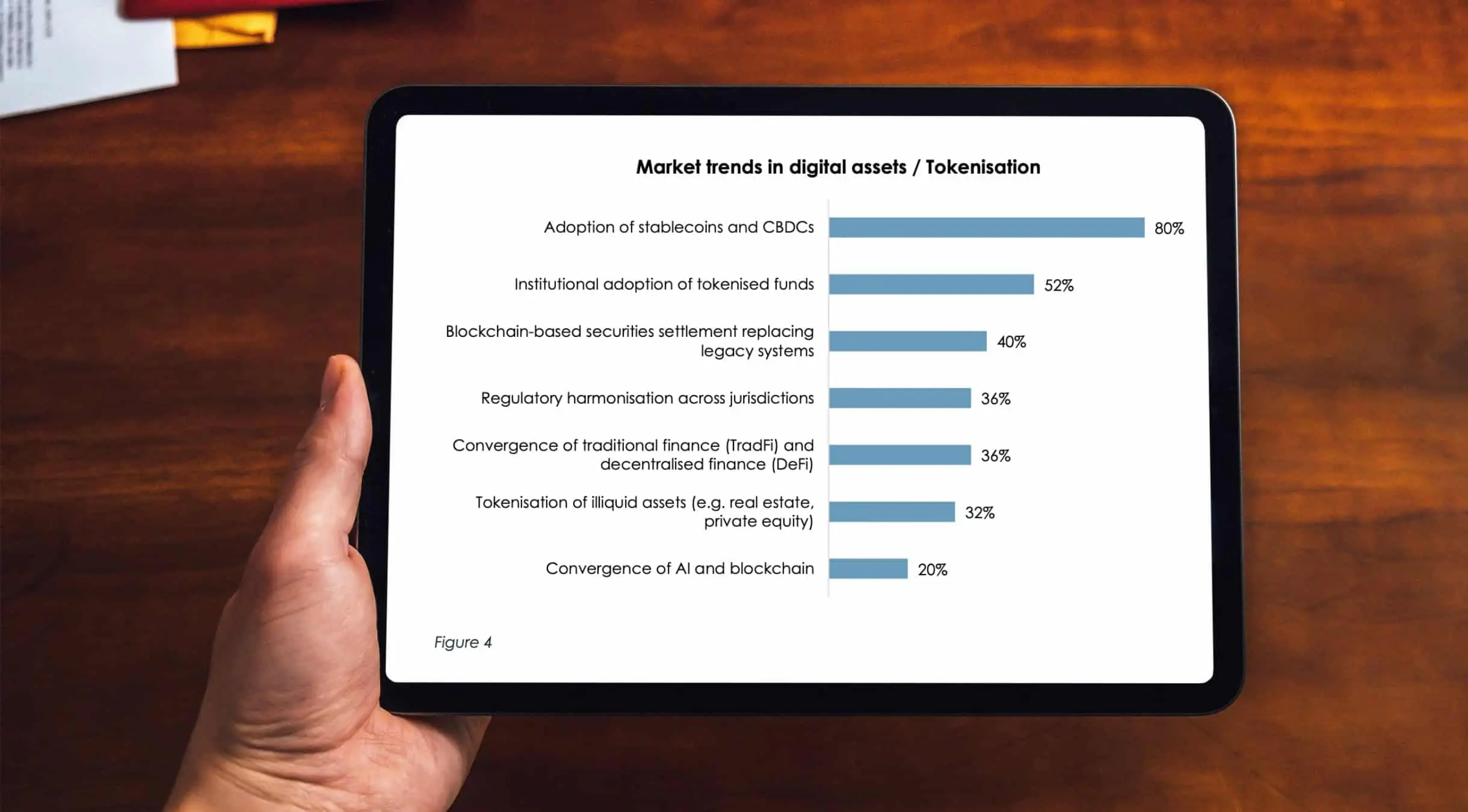
The survey, which polled 25 financial institutions in Switzerland and Liechtenstein in Q3 2026, found that 80% of respondents identified the spread of stablecoins and CBDCs as the leading market trends in digital assets and tokenization over the next three to five years, far ahead of any other trends. The institutional adoption of tokenized funds came in second, cited by 52% of respondents.

A middle group of trends presents a range between 32% and 40%. Blockchain-based securities settlement replacing legacy systems was noted by 40% of respondents, regulatory harmonization across jurisdictions by 36%, the convergence of traditional and decentralized finance by 36%, and the tokenization of illiquid assets by 32%. The convergence of artificial intelligence (AI) and blockchain received the fewest mentions, at 20%.

These trends conflict with Swiss and Liechtenstein financial institutions’ own plans. While stablecoins and CBDCs lead the trend ranking, most institutions do not provide or do not intend to provide stablecoin or settlement services.
Stablecoin and settlement solutions showed visible but limited maturity, with 20% of institutions offering such services, while a further 20% planned to do so. 60% had no plans in this area.

The same disparity applies to tokenized assets. Only 12% of institutions had introduced an offering and a further 24% were in the planning stage. Together, just 36% of institutions had tokenized assets either in their offering or on their agenda. The vast majority, 64%, reported that they currently had no plans.

Specifically, 8% of respondents offered tokenization of equity or fund instruments, and a further 12% were planning to do so. 80% of institutions have no plans in this area.
Next, tokenization of other assets or rights appeared in 4% of responses, with 8% planning such services. Tokenization of real estate or real assets and debt instruments each show 8% of respondents offering them, with no further plans noted.
Economic and organizational challenges
According to the research, the reluctance to offer these solutions despite these being seen as the most critical in the coming years, stem mainly from economic and organizational factors.
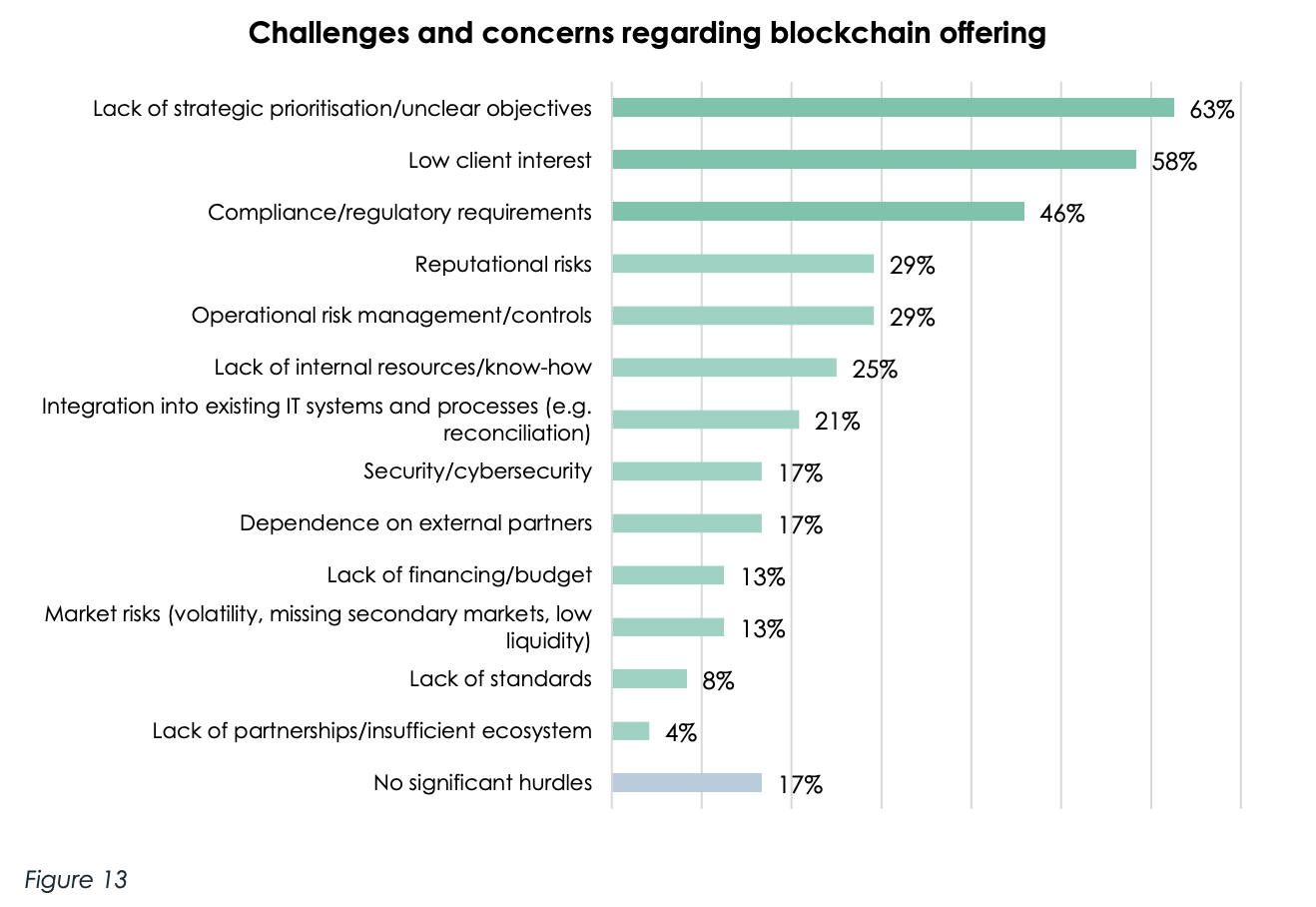
63% of Swiss and Liechtenstein financial institutions cited a lack of strategic prioritization or an insufficient business case as a hurdle to expanding blockchain offerings, 58% mentioned low customer interest, and 46% pointed to regulatory or compliance requirements. These findings suggest that the limitations on offerings are less technical and more commercial in nature.
At the same time, 87% of the responses regarding the main drivers relate to growth, expansion of offerings, or customer retention. In particular, growth, new client acquisition and product expansion were identified as the top drivers, cited by 48% of respondents, followed by client retention and/or the prevention of asset outflows, cited by 39% of respondents.
This reveals an ambivalence where economical motives are guiding ambitions, but where true customer demand and profitability remain unproven.

Swiss banks’ digital assets, blockchain strategies
Swiss financial institutions have so far concentrated on cryptocurrency services. 68% of the institutions polled offered a corresponding service, with custody and trading each provided by 64% of respondents.
However, research by Blockstories, a European research and media company focused on digital assets, shows varied strategies. Global universal banks like UBS have embraced tokenization ahead of crypto access, prioritizing tokenized bonds, structured products, and money-market funds.
By contrast, domestic and retail banks were early adopters of crypto banking products through services including buy-and-hold trading, custody within online banking, and transfers.
Swiss private banks were other early adopters of crypto services, targeting clients with crypto fortunes. Some started by accepting crypto transfers and providing lending, staking, and banking for crypto firms from the start, while others restricted themselves to execution-only trading or crypto-linked products.
This expanding ecosystem is developing as crypto investment rises steadily in Switzerland. A study by IFZ Zug, a research institute of the Lucerne University of Applied Sciences, polled more than 1,700 people in Switzerland in Q1 2026, and found that 18% of respondents held cryptocurrencies.
The figure represents a 2-point increase from the previous year and a 7-point increase from 2024. Based on Switzerland’s total population, this implies that roughly 140,000 new crypto investors entered the market between 2025 and 2026.
Featured image: Edited by Fintech News Switzerland, based on image by 21studio via Magnific