


Switzerland’s UBS ranks sixth this year in AI maturity among global banks, sustaining its European lead in adopting and integrating the technology for four consecutive years, according to a new research by Evident Insights, an intelligence platform that tracks AI adoption across financial services.
This leadership arises from strong workforce enablement and scaled deployment across multiple functions.
The Evident AI Index, launched in 2023, is a global benchmark for AI maturity in the finance sector, evaluating AI talent, innovation, leadership, and transparency. It assesses metrics including talent capability and development, research and patents, executive positioning, and responsible AI leadership.

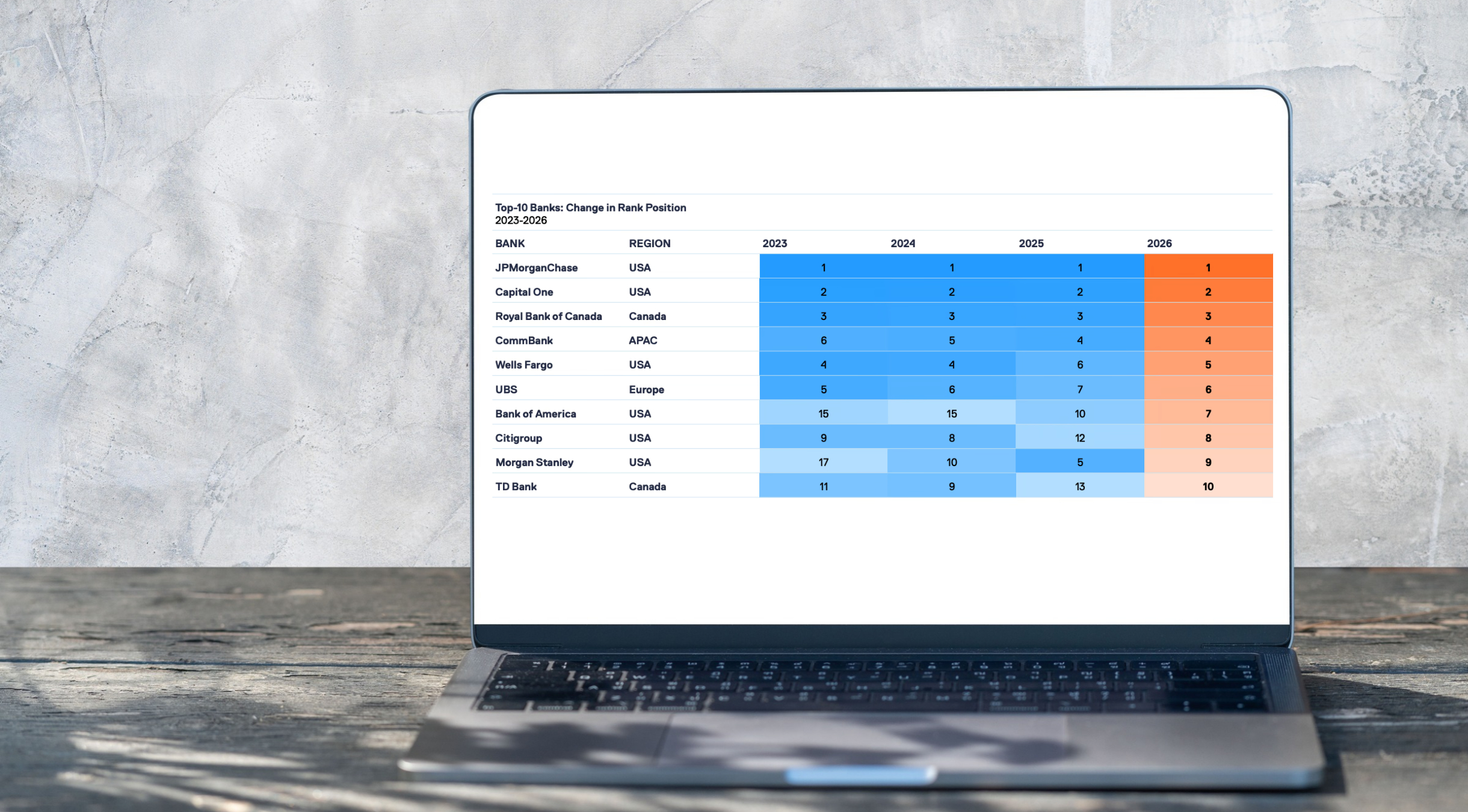
In the 2026 Evident AI Index Rankings, UBS holds sixth place worldwide, sustaining a relatively steady position since 2023 by moving between fifth and seventh. The Swiss bank remains the sole European institution in the top 10.

A deep talent pool
According to the research, UBS’s strong performance this year reflects an increasingly coordinated approach to AI integration encompassing workforce enablement and scaled deployment.
UBS now boasts the 6th largest AI workforce globally, and the largest in Europe, having successfully retained much of Credit Suisse’s AI talent base through the integration.
The bank is also complementing that specialist base with enterprise-wide upskilling programs. Since 2024, more than 49,000 employees at UBS have enrolled in AI-related online courses, and more than 38,000 employees have completed AI learning journeys to date.
By July 2026, more than 21,000 employees, or 28% of UBS’ workforce, had finished the UBS AI Citizen, an internal program that teaches AI literacy, real-world use cases, workplace productivity, and the responsible use of AI tools. Additionally, more than 96% of managers had completed the initial stages of AI Enabler, a program supporting managers in applying AI to team practices and people leadership.
Impact of AI at UBS
This expansive talent base is translating into deployment. In 2025, UBS launched more than 300 AI use cases across its operations.
The bank’s AI-powered Global Research tools, embedded directly into research workflows, started with simple yet high-impact features such as AI-assisted titles and email hooks. These tools have been used more than 15,000 times, and have increased email open rates by 16%.
Work then expanded into developing a broader analyst toolkit that now supports nearly 1,000 global research professionals, where UBS’ CoAuthor tool, used more than 30,000 times, strengthens clarity, consistency and overall content quality.
UBS’ Harvey, a platform built for legal functions, enables high-quality drafting, summarization, and review of complex legal content, powered by models trained specifically on legal language and structures.
The bank claims the increased efficiency from Harvey delivers direct cost savings of at least US$1 million. It also enables the insourcing of external legal work, generating an additional US$1 million in savings in 2026 alone, while significantly improving decision-making and risk anticipation.

2026 Evident AI Index Rankings
The 2026 Evident AI Index highlights a rapid rise in AI deployment across the global banking sector. In 2026, the average bank score jumped 26%, rising 9.6 points year-over-year and reaching nearly three times the moving average observed between 2023 and 2025.

Since 2023, the top ten leaders in the Evident AI Index have remained consistent. All of this year’s top performers have placed in the top ten at least once before, six have done so every year, and the top three perennial leaders, namely JP Morgan Chase, Capital One, and the Royal Bank of Canada (RBC), have remained undisputed.
The research found that AI deployment is producing favorable results. In particular, the top ten banks reported more and better outcomes from AI use cases than the rest of the cohort. These banks accounted for 25% of AI use cases that include impact claims, but demonstrated a higher share of use cases documenting operational metrics (34%) or a direct financial result (50%).

AI adoption in Switzerland
In Switzerland, AI adoption is rapidly and broadly making its way into businesses. A EY survey polled more than 600 respondents from companies across the country and found that AI is used by 89% of respondents in their daily work. In particular, access is increasingly provided through integrated workplace tools like Microsoft Copilot or Google Workplace with Gemini (70%), though specialized and proprietary solutions continue to gain traction (33%).

While AI adoption in Switzerland is widespread, relatively few companies have embedded AI into their core business strategy. Only 9% of respondents reported AI as a core element that has already transformed their business models, while 63% have either deployed AI solutions or were conducting AI pilot projects.

Featured image: Edited by Fintech News Switzerland, based on image by nirat.pix via Magnific