


Close Menu
    • Top Fintech Startups in Switzerland
    • Switzerland Fintech Startup List
    • Virtual Banking
    • Open Banking
    • Online Mortgage
    • Regtech
    • Fintech Events
    • Submit Press Release
    • Submit Startup
    Facebook LinkedIn X (Twitter) Instagram RSS
    • About Fintech News Network
    • Media Kit
    • Contact Us
    • Work With Us
    • Newsletter
    • Submit Press Release
    • Submit Startup
    • Impressum
    Fintech Schweiz Digital Finance News – FintechNewsCH
    part of Fintech News Network

    Fintech News Network

    Facebook LinkedIn X (Twitter) Instagram RSS
    Free Newsletter
    • Blockchain
    • Wealthtech
    • Lending
    • Mobile Payments
    • Insurtech
    • PFM
    • AI
    • Funding
    • Various
      1. Germany
      2. London
      3. USA
      4. Austria
      5. Liechtenstein
      6. View All

      Mambu Investor CommerzVentures Unveils €50M Fund IV for AI Fintech Startups

      November 25, 2026

      BaFin Fines Deutsche Bank €8 Million Over Postbank Migration Issues

      November 13, 2026

      Affirm Acquires Ratepay as Nexi Focuses on Core Activities

      November 10, 2026

      Eurex Clearing to Handle Digital and Traditional Assets Together

      November 4, 2026

      HSBC, J.P. Morgan and StoneX Test Gold Ownership as Collateral

      November 25, 2026

      Zodia Markets Names Crypto Finance Founder Jan Brzezek as CEO

      November 24, 2026

      Payhawk Reaches US$2 Billion Valuation in Goldman Sachs-Led Series C

      November 20, 2026

      Griffin Raises US$20M to Add Card and Stablecoin Services

      November 13, 2026

      GTCR Seeks Equity Backing for US$50B Global Payments Buyout

      November 26, 2026

      PayPal Appoints New Leaders to Execute Its Three-Year Strategy

      November 24, 2026

      CrowdStrike Agrees to Buy Zscaler in US$43.9 Billion Share Deal

      November 24, 2026

      Databricks Eyes US$225 Billion Valuation in Early Funding Talks

      November 24, 2026

      Revolut Austria Banking Branch to Launch in 2027 With Local IBANs

      November 5, 2026

      BingX EU Secures MiCA Licence for Crypto Services in Europe

      October 15, 2026

      Bitget Pauses Withdrawals Following US$351.6M Hot Wallet Hack

      September 25, 2026

      Bybit Payments Secures Austria EMI License for European Payment Services

      August 5, 2026

      Swiss and Liechtenstein Banks Resist Core Banking System Overhaul

      November 11, 2026

      Swiss Blockchain Survey 2026: Banks on Stablecoins and Tokenized Funds

      October 20, 2026

      Bank Frick Enables Real-Time Euro Transfers and CHF Payment Receipts

      July 21, 2026

      Celsion Bank Begins Operations, Combining Digital Assets and Traditional Banking

      April 10, 2026

      Anthropic Zurich Office Rent Estimated at CHF 2 Million a Year

      November 26, 2026

      Enfuce Appoints Vanessa Schotes as Chief Operating Officer

      November 24, 2026

      Lauren Boyman Joins Broadridge from KPMG as Marketing Chief

      November 19, 2026

      Top Finfluencers in Switzerland in 2026

      November 10, 2026
    • More
      • Fintech Events
      • Top Swiss Fintechs in 2026
      • Swiss Fintech Startup List
      • Accelerators
    Fintech Schweiz Digital Finance News – FintechNewsCH

    Fintech News Network

    Home»Blockchain»Blockchain – to Replace Government in Real Estate
    Blockchain

    Blockchain – to Replace Government in Real Estate

    Sacha HuberSacha HuberMay 27, 20168 Mins Read
    LinkedIn Facebook Twitter Telegram Copy Link Email
    Real estate blockchain
    Share
    Facebook Twitter LinkedIn Telegram Copy Link Email
    Free Newsletter

    Get the hottest Fintech Switzerland News once a month in your Inbox

    When it comes to blockchain, the immutable ledger technology that underpins bitcoin, much of the limelight thus far has been on its potential to disrupt the finance industry. However, the transformation that real estate may experience from applying blockchain could arguably be just as profound. Unlike financial services, where technological innovation has largely been embraced in the pursuit of profit, much of real estate’s business conduct remains firmly stuck in the past. Many operating methods within the industry have remained unchanged for 50 years, if not longer.


    What is a land-registry in a blockchain?

    Land registry systems contain records of a country’s land transactions, and operate on centralized ledger systems at present, with the centralized entity normally being a government agency. At their best, the systems guarantee title of all land assets; however, in reality they provide incomplete security of tenure, are marred by corruption and frequently result in ownership disputes. In contrast, a blockchain land registry system would be decentralized.

    This would mark a distinct improvement on the incumbent system, in that every authorized network member would have an authenticated copy of the registry, rather than just one centralized party. Given that everyone can see the records, therefore, the process would be more transparent, which again minimizes the potential for foul play. Removal of the centralized entity is also likely to be cheaper and more efficient – the operating cost of the land registry in England and Wales in 2013/14, for example, was nearly £240 million.

    Bottomline

    Ragnar Lifthrasir, who is President of the International Bitcoin Real Estate Association (IBREA), is among the pioneers in developing a real estate model which can operate on the blockchain. He identifies three specific uses of the technology in the industry – purchasing, escrowing and the recording of title ownership and associated transfers. Escrowing is perhaps the least developed idea currently, although ostensibly it would be similar to a common bank transfer, only in this case the transferable amount is first converted to bitcoins which are then put into escrow. Nevertheless, as long as both parties agree to use the blockchain over a government solution, Lifthrasir argues, then nothing can stop them.


    What are the benefits?

    A blockchain would allow someone to upload land title documentation to the network, which other users can record and verify if needed. This would provide proof that this person is the first owner of the documents, and decentralised network verification would prevent forgery. When it’s time to transfer title, the document simply requires ‘rehashing’ (encrypting) by the owner to prove he/she is in possession of the document.

    During the actual transfer process, a ‘coloured coin’ system – which US stock exchange Nasdaq currently uses to settle securities – would be employed. A concept first outlined by Swiss computer scientist and Bitcoin core developer Mike Hearn, coloured coins are non-fungible tokens which provide the owner with private keys, thus allowing only the owner to transfer ownership while preventing fraudsters from corrupting the process.

    The elimination of costs associated with title insurance and fraud, according to Lifthrasir, is the biggest advantage of using blockchain. This has been a persistent problem with the current system of centralised government records. Criminals are able to fake title ownership, often simply by using editing software to stipulate transfer of property ownership in their favour, and at negligible expense. Indeed, title insurance itself is a $20 billion industry, and Lifthrasir estimates that at present it is costing around $1 billion to combat title fraud.

    Some argue for a replacement of the entire common law system, which currently requires a laborious examination process of public land records before a plot of land is transferred from one party to the other. Joe Dewey and Shawn Amuial, attorneys at US law firm Holland & Knight who specialise in real estate and finance, for instance, are in favour of replacing the government recording of deeds, mortgages and other instruments in land records with the blockchain, as government records are prone to human error and corruption.


    Reducing Bribery and Corruption

    Indeed, corruption within land registry has plagued much of the developing world, with insufficiently secure governmental systems being regularly prone to manipulation. Honduras is among the worst. USAid Land Tenure estimates that 80% of privately held Honduran land is untitled or improperly titled, while only 14% of citizens legally occupy properties, with less than a third of those citizens being officially registered. Land title disputes in Honduras have led to violent conflict and widespread fraud, with cases of the registry system databases being hacked into and bureaucrats being able to secure the most luxurious properties.

    As a solution, US technology start-up Factom announced in May 2015 that it had agreed to build a secure land title record system for the Honduran government using blockchain technology, in conjunction with title software company Epigraph. Transferring land records onto the blockchain, therefore, could be a reality in the not too distant future.

    In doing so, Factom CEO Peter Kirby believes that Honduras’ land registry system would leapfrog many systems in the developed world. Although recent reports suggest that the partnership has stalled, Factom is adamant that progress is still being made, so it may take longer for the project to come to fruition than initially thought.

    Ghanaian NGO Bitland also claims to be developing a blockchain-based system for entering land title records, in a bid to correct for the numerous failed attempts by the government to develop a fair and efficient land administration system. At present, courts in Ghana are reportedly being inundated with land dispute cases.

    Bitland hopes to reduce this burden, and will use the Factom/Epigraph technology, as well as satellites and GPS to verify the accuracy of plots of land. Buyers will also be able to discover the last owner of property rights and land ownership disputes, while the disputes themselves can be made visible to the network, thus ensuring greater security. However, as with Honduras, much work is yet to be done.

    Registry system problems, moreover, are not solely confined to the developing world. The US State of Massachusetts has a specific court which has jurisdiction over the registration of title to real property, while in Canada, 95% of land in Newfoundland and Labrador is considered Crown Land, which results in land disputes regularly ending up in court. Kirby believes that the most important issue is for courts to have a true history of what has happened during such land dispute cases. Immutable records based on “evidence and precedent” will be instrumental in adjudicating land disputes, and can also then become part of the permanent record of the land, which the blockchain technology can ensure.

    In terms of taking land title records away from government and onto the blockchain, it may prove to be more difficult in some countries than others. In the US, for instance, title companies exist and have large databases of land ownership records, in addition to the government’s own records.

    The sheer number of landowners (and thus the number of records), coupled with the overall size of the US, makes the task of shifting from government records to blockchain a lot tougher. However, Dewey and Amiual point to the fact that title companies are likely to act as allies in the technology’s development, rather than enemies, especially if title insurance can still play a role in addressing those risks which are not eliminated by the blockchain.

    Lifthrasir believes blockchain will offer significant improvements over the current government-administered system. It would allow the industry to avoid the inefficiencies that arise from the presiding record keeping practices used by government. While Kirby is willing to work alongside the government in the Honduran case, Lifthrasir does not think it is a worthwhile investment of people’s time to teach governments about blockchain. The opportunity to transact directly under blockchain means that the role of government becomes redundant.


    Conclusion

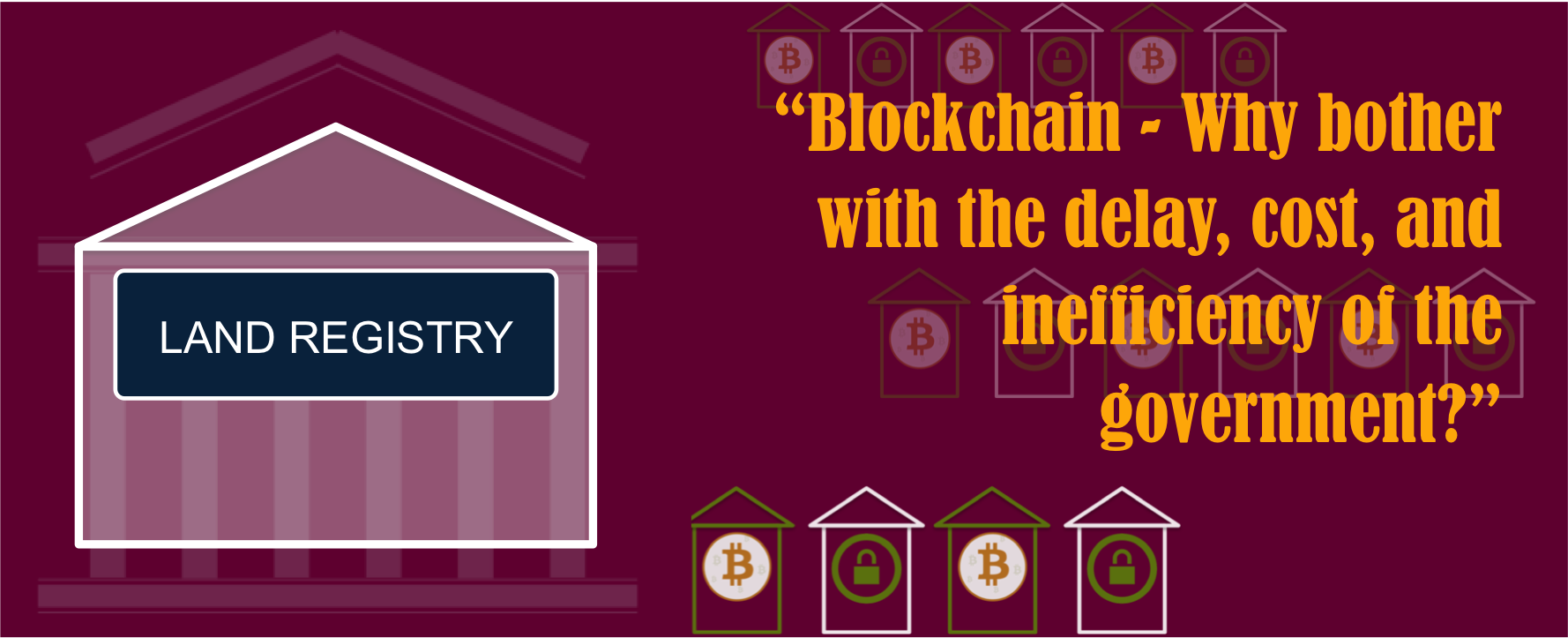
    Instead, IBREA’s intention is to gather together the real estate industry professionals who favour moving elements of the business onto the blockchain, especially operations pertaining to purchasing, escrowing, and recording of transfer of properties. As Lifthrasir puts it, “So, as long as people in the real estate industry start deciding to use the Bitcoin blockchain to record the transfer of properties, why bother with the delay, cost, and inefficiency of the government?” He is convinced that 2016 will be the year that title management moves onto the blockchain, and in turn, that the technology is developed enough to be used in the real estate industry.


    Sponsored ReportThe Payments Intelligence GapRead
    Bribery and Corruption Government replacement Blockchain International Bitcoin Real Estate Association Land Registry Land Registry privatization Ragnar Lifthrasir
    Share. Facebook LinkedIn Twitter Telegram Copy Link Email

    Author

    sacha huber kpmg
    Sacha Huber
    • LinkedIn

    Sacha is Assistant Manager, Audit FS at KPMG Switzerland

    Related Posts

    BIT Asset Management Lists Swiss Bitcoin ETF on SIX

    November 26, 2026

    Switzerland Plans to Start Sharing Cryptoasset Tax Data in 2028

    November 26, 2026

    Relai Stacks Adds Goal-Based Bitcoin Saving for Swiss and EU Users

    November 25, 2026

    SNB Starts Exploratory Work on a Swiss Financial Ledger

    November 25, 2026

    Zodia Markets Names Crypto Finance Founder Jan Brzezek as CEO

    November 24, 2026

    AMINA Bank Opens OUSD Stablecoin Access to Institutional Clients

    November 23, 2026

    Tether Backs SCRYPT as It Expands into Stablecoin Payments

    November 20, 2026

    AMINA Bank Staking Expands to 10 Assets with SUI and NEAR

    November 19, 2026
    Fintech Newsletter
    Subscribe to the most important Fintech Switzerland News
    Follow Us
    • Facebook
    • X / Twitter
    • LinkedIn
    • Instagram
    Swiss Fintech Startup Directory

    Swiss Fintech Startup Directory

    Top Swiss Fintech Startups

    Top Fintech Startups in Switzerland for 2026

    Upcoming Fintech Events
    Country
    Fintech Pulse 2026
    November 27, 2026
    Latvia
    -
    Riga
    Fintech Week LDN 2026
    November 30, 2026
    -
    December 4, 2026
    United Kingdom
    -
    London
    FinTech Connect 2026
    December 1, 2026
    -
    December 2, 2026
    United Kingdom
    -
    London
    Swiss InsurTech Summit & Awards 2026
    December 1, 2026
    Switzerland
    -
    Zurich
    Digital Finance Summit 2026
    December 3, 2026
    Belgium
    -
    Brussels
    Promote Event View More
    Whitepapers & E-Books
    The Future of Competitive Advantage in Banking & Payments
    The Future of Competitive Advantage in Banking & Payments
    Bottomline
    American Newsletter

    Fintech News America

    Australia Fintech Map

    Australia Fintech Map

    Philippines Fintech Report

    SINGAPORE FINTECH REPORT

    Singapore Fintech Map 2025

    Indonesia Fintech Report

    Indonesia Fintech Map 2025 banner

    UAE Fintech Report

    UAE Fintech Report 2024

    Free Business Accounts

    Navigation
    • About Fintech News Network
    • FNN Media Kit
    • Work With Us
    • Contact Us
    • Fintech Switzerland Newsletter
    • Submit Press Release
    • Submit Fintech Startup
    • Datenschutzerklärung / Impressum
    Other Fintech News Network Publications
    Fintech News Switzerland
    Fintech News Singapore
    Fintech News Malaysia
    Fintech News Hong Kong
    Fintech News Philippines
    Fintech News Network Indonesia
    Fintech News Network Australia
    Fintech News Baltic
    Fintech News Nordics
    Fintech News America
    Fintech News UAE
    Fintech News Africa
    Get Informed

    Subscribe to Updates

    Subscribe to the most important Fintech Switzerland News

    Facebook LinkedIn X (Twitter) Instagram RSS
    • About Fintech News Network
    • FNN Media Kit
    • Work With Us
    • Contact Us
    • Fintech Switzerland Newsletter
    • Submit Press Release
    • Submit Fintech Startup
    • Datenschutzerklärung / Impressum
    © 2015 - 2026 Copyright CK Finanzpro GmbH. All Rights reserved.

    Type above and press Enter to search. Press Esc to cancel.

    Fintech Schweiz Digital Finance News - FintechNewsCH
    Manage Consent

    Your Privacy Matters to Us

    To provide the best experiences, we use technologies like cookies to store and/or access device information. Consenting to these technologies will allow us to process data such as browsing behavior or unique IDs on this site. Not consenting or withdrawing consent, may adversely affect certain features and functions.

    Functional Always active
    The technical storage or access is strictly necessary for the legitimate purpose of enabling the use of a specific service explicitly requested by the subscriber or user, or for the sole purpose of carrying out the transmission of a communication over an electronic communications network.
    Preferences
    The technical storage or access is necessary for the legitimate purpose of storing preferences that are not requested by the subscriber or user.
    Statistics
    The technical storage or access that is used exclusively for statistical purposes. The technical storage or access that is used exclusively for anonymous statistical purposes. Without a subpoena, voluntary compliance on the part of your Internet Service Provider, or additional records from a third party, information stored or retrieved for this purpose alone cannot usually be used to identify you.
    Marketing
    The technical storage or access is required to create user profiles to send advertising, or to track the user on a website or across several websites for similar marketing purposes.
    • Manage options
    • Manage services
    • Manage {vendor_count} vendors
    • Read more about these purposes
    View preferences
    • {title}
    • {title}
    • {title}