

Close Menu
    • Top Fintech Startups in Switzerland
    • Switzerland Fintech Startup List
    • Virtual Banking
    • Open Banking
    • Online Mortgage
    • Regtech
    • Fintech Events
    • Submit Press Release
    • Submit Startup
    Facebook LinkedIn X (Twitter) Instagram RSS
    • About Fintech News Network
    • Media Kit
    • Contact Us
    • Work With Us
    • Newsletter
    • Submit Press Release
    • Submit Startup
    • Impressum
    Fintech Schweiz Digital Finance News – FintechNewsCH
    part of Fintech News Network

    Fintech News Network

    Facebook LinkedIn X (Twitter) Instagram RSS
    Free Newsletter
    • Blockchain
    • Wealthtech
    • Lending
    • Mobile Payments
    • Insurtech
    • PFM
    • AI
    • Funding
    • Various
      1. Germany
      2. London
      3. USA
      4. Austria
      5. Liechtenstein
      6. View All

      Eurex Clearing to Handle Digital and Traditional Assets Together

      November 4, 2026

      Deutsche Börse Extends Access to DAX 40 Stocks Beyond Xetra Hours

      October 28, 2026

      HSG Robotaxi Report: Positive Experience Despite Early Stage Rollout in Europe

      October 14, 2026

      HANSAINVEST Brings AI and Tech ETF to SIX Swiss Exchange

      September 21, 2026

      UBS Job Cuts Hit London as Credit Suisse Integration Enters Final Phase

      November 6, 2026

      Monzo Weighs New Funding at £7.5 Billion Valuation as Buyout Talks Stall

      November 6, 2026

      Sequoia Closes London Office as Part of Wider Changes

      November 5, 2026

      Canada’s CIBC Taps Thought Machine for Retail Banking Overhaul

      October 30, 2026

      Sequoia Closes London Office as Part of Wider Changes

      November 5, 2026

      Ripple Expects US$900M Run Rate as Multi-Product Clients Triple

      October 29, 2026

      Stripe Pay Launches Instant Business Transfers in US and UK

      October 29, 2026

      Ripple, BNY Expand Partnership to Explore Tokenised Trade Finance

      October 28, 2026

      Revolut Austria Banking Branch to Launch in 2027 With Local IBANs

      November 5, 2026

      BingX EU Secures MiCA Licence for Crypto Services in Europe

      October 15, 2026

      Bitget Pauses Withdrawals Following US$351.6M Hot Wallet Hack

      September 25, 2026

      Bybit Payments Secures Austria EMI License for European Payment Services

      August 5, 2026

      Swiss Blockchain Survey 2026: Banks on Stablecoins and Tokenized Funds

      October 20, 2026

      Bank Frick Enables Real-Time Euro Transfers and CHF Payment Receipts

      July 21, 2026

      Celsion Bank Begins Operations, Combining Digital Assets and Traditional Banking

      April 10, 2026

      Zodia Markets Joins Bank Frick’s xPULSE Network for Faster Fiat Settlement

      December 3, 2025

      MUFG Bank Europe Absorbs Securities Arm to Become EU Universal Bank

      November 4, 2026

      Swiss Officials Weigh the Costs of a UBS Relocation Abroad

      October 30, 2026

      Lagarde to Step Down as ECB President on 7 February 2027

      October 30, 2026

      Top 9 Emerging Fintech Providers from Europe

      October 28, 2026
    • More
      • Fintech Events
      • Top Swiss Fintechs in 2026
      • Swiss Fintech Startup List
      • Accelerators
    Fintech Schweiz Digital Finance News – FintechNewsCH

    Fintech News Network

    Home»Various»EU Financial Institutions Employ Deceptive UX Design, Addictive App Features
    Various

    EU Financial Institutions Employ Deceptive UX Design, Addictive App Features

    Over the past years, dark patterns have spread widely in the EU, employing sophisticated design tactics that trick online users towards choices that are not always in their best interest but that benefit companies.
    Fintechnews SwitzerlandFintechnews SwitzerlandOctober 21, 20267 Mins Read
    LinkedIn Facebook Twitter Telegram Copy Link Email
    EU Financial Institutions Employ Deceptive UX Design, Addictive App Features, New Study Finds
    Share
    Facebook Twitter LinkedIn Telegram Copy Link Email
    Free Newsletter

    Get the hottest Fintech Switzerland News once a month in your Inbox

    In Europe, manipulative design practices, addictive application features, and finfluencer-driven promotion of risky or misleading financial products, are widespread, according to a new study by Finance Watch, an independent European non-governmental organization (NGO) serving as a public-interest counterweight to private financial lobbies.

    These methods benefit financial institutions by undermining customers’ ability to make clear, informed, and free decisions, prompting calls for legislative action.

    The study, conducted by the Behaviouralist, examined 24 financial institutions’ websites and mobile applications across four European Union (EU) countries from April to June 2026. It found extensive use of so-called dark patterns and addictive features designed to spur impulsive decisions and exploit cognitive biases.

    Dark patterns, also known as deceptive user experience (UX) patterns, are design tactics that trick online users into making choices that aren’t always in their best interest. In the context of financial services, these practices can mislead consumers into making investment decisions that result in significant financial detriment, in particular for vulnerable consumers, but which are beneficial to the company.

    Most prevalent manipulative design tactics

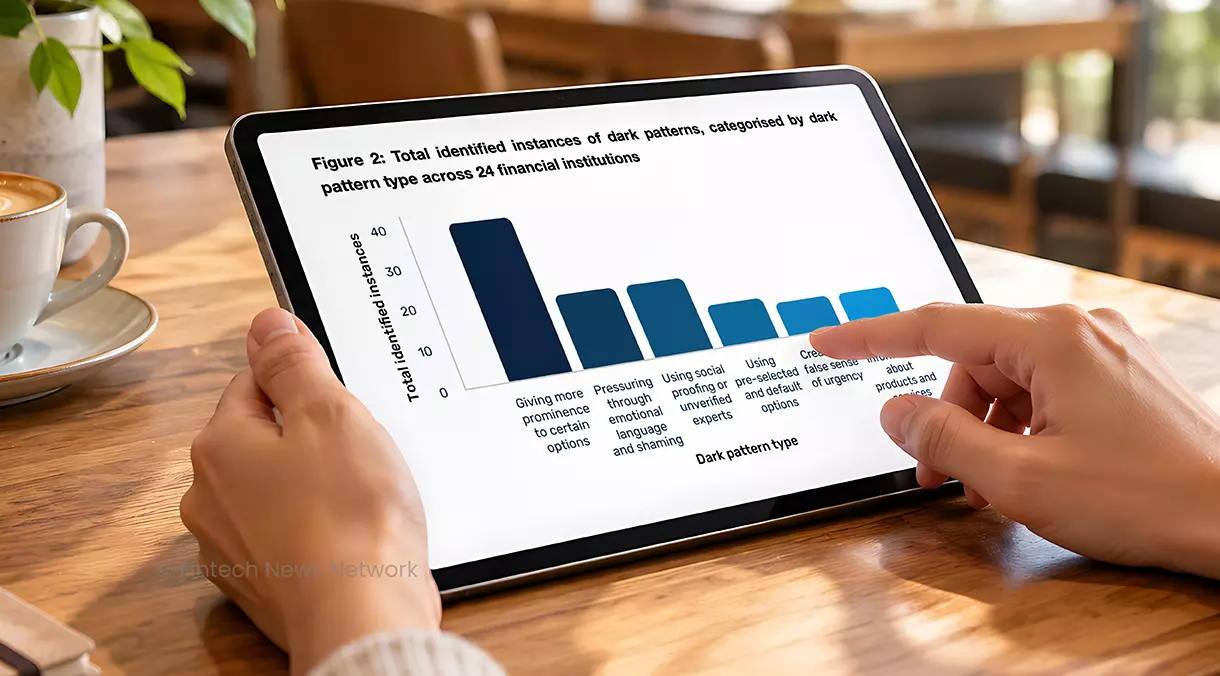
    The study found that among financial institutions’ websites and apps, the most prevalent manipulative design feature involved giving more prominence to certain options when asking consumers to make choices, observed in 40 instances across the 24 financial institutions.

    This type of dark pattern is typically used to guide customers towards the option that is most beneficial to the firm but not necessarily in the interest of the consumer.

    One particular example used lists of trending investment products on the user interfaces, ranking assets according to predefined criteria, thereby directing users’ attention towards specific options. Another example involved the use of recommendation features to give more prominence to an option the firm wants the consumer to choose, like a higher-fee generating product, identified in 19 instances across the sample.

    The use of emotional language and shaming to nudge consumers towards a particular decision was another prominent manipulative design feature in the sample, with 19 instances observed.

    A popular technique here was the use of loss-aversion framing through banners shaming users into investing in a particular retail investment product by pointing out that they would lose out otherwise.

    Examples included statements, such as “Did you know that money can lose value?” and that “inflation will erode purchasing power”, positioning investment as a way to avoid this loss. An interactive calculator would sometimes be displayed projecting users’ losses from non-investment, effectively shaming consumers into taking action.

    Financial institutions also relied on the use of social proofing and misrepresentations or unverified expert or institutional opinions, tactics observed 19 times in the sample. Examples included misleading analyst recommendations, star ratings, or fake “expert” commentary designed to reduce users’ critical evaluation of investment decisions because they come from a perceived authority.

    In particular, the study identified instances of analyst recommendations without context, creating a particularly strong authority bias effect by removing uncertainty and caveats that would support more balanced decision-making.

    Another troubling example was a page featuring investment ideas, among them supposedly from famous investors such as Warren Buffett or Bill Gates. These features appeal to consumers’ behavioral biases, prompting them to invest in the options presented, despite those options being only loosely related to these famous investors.

    Pre-selected or default options appeared in 11 instances, mostly in trading apps, while obscuring important product information, such as key details about risks, was seen in nine cases. These are designed to limit consumers’ ability to make informed decisions and raise the chance of buying an unsuitable product or making an unsuitable investment.

    Another frequently observed dark pattern, identified in nine instances as well, was the use of design features that create a false sense of urgency, such as time-limited offers, countdown timers, and urgency-inducing deadlines. These aim to pressure users to make investment decisions more quickly than they otherwise would.

    Total identified instances of dark patterns, categorized by dark pattern type across 24 financial institutions
    Total identified instances of dark patterns, categorized by dark pattern type across 24 financial institutions, Source: Dark patterns, addictive design and misleading influencer marketing: How Europe’s online retail investment market steers consumer decisions, Finance Watch, Sep 2026

    Addictive design features and the role of finfluencers

    The study also found that financial institutions in the EU relied on addictive design features to exploit psychological vulnerabilities, extend user engagement, and drive compulsive behavior.

    In particular the use of live retail investment product performance updates in firms’ mobile apps was identified in 19 instances, nudging users towards executing an impulsive trade and exploit investors’ cognitive bias.

    The research also examined finfluencer practices, examining content traits, key messages, risk communication, disclosure of ties to financial providers and monetization, and behavioral techniques. It covered 15 financial influencers from Spain, Germany, Hungary, and Czechia with substantial audience reach and visibility based on country-specific rankings, follower counts and platform engagement metrics.

    Roughly 54% of the 59 individual pieces of finfluencer content analyzed were presented as educational in nature rather than as advertisements. Many finfluencers in the sample even went so far as claiming to teach financial knowledge that schools and traditional institutions do not provide.

    Yet, none held a formal financial advisory license or regulated credential, nor did any explicitly present themselves as a “certified financial adviser.”  Instead, creators tended to rely on personal investment experience, claims of entrepreneurial success, references to books or mistakes they had learned from, citations of well-known investors, and references to media or “financial experts”.

    This carries high risk for consumers because most of these influencers lack the competence to speak about finance and many have commercial interests in the products they are talking about.

    One concerning pattern among these finfluencers was the use of social media content to funnel audiences into private or paid spaces, such as Patreon, Discord, online courses, academies and membership programs, where consumers are told they will receive financial education lessons.

    Inside these private, paid communities, the messages provided may be advertising instead of purely educational and may even constitute investment advice. In the worst case, these offers marketed as “educational” can turn out to be outright scams.

    In the US, a social media influencer was sentenced to six years in prison in April 2026 for orchestrating a US$20 million real estate Ponzi scheme and committing tax fraud to further that scheme. He promoted the investments, often promising a rate of return of 30% or more, through social media, especially Facebook and YouTube.

    In the UK, a coordinated week of action on finfluencers in June 2025 involved nine international regulators and resulted in three arrests, six criminal proceedings, 11 targeted warning or cease-and-desist letters, 50 warning list alerts and 650 social media takedown requests.

    Addressing malpractices

    These findings indicate that while the digitalization of the retail financial services market offers important opportunities, such as ease of access to services, it also introduces new risks that can erode trust in capital markets and the financial sector more broadly.

    In this context, Finance Watch proposes a set of policies suited to the upcoming Digital Fairness Act (DFA) in the EU. It suggests a general prohibition of misleading design features that influence consumer choices, such as dark patterns, in the Unfair Commercial Practices Directive (UCPD), and calls for prohibiting common forms.

    It also suggests requiring firms to disable by default any feature that might trigger addiction-like behavior, such as excessive push notifications in the UCPD, and to prohibit finfluencer advertising and marketing of retail investment products.

    Finally, it recommends mandatory registration and licensing for financial influencers who teach financial literacy skills. These licensing rules should include basic competency standards, such as financial knowledge, along with record-keeping duties to support supervision and enforcement.

    Over the past years, dark patterns have spread widely in the EU, with 97% of the 75 most popular websites and apps used by consumers in the region deploying at least one, according to a report by the European Commission. Common types include hidden information or false hierarchy, preselection, nagging, difficult cancellations, and forced registration.


    Featured image: Edited by Fintech News Switzerland, based on image by Sketch Graphic via Magnific

    Sponsored ReportThe Payments Intelligence GapRead
    addictive design features dark patterns finfluencers malpractice regulation
    Share. Facebook LinkedIn Twitter Telegram Copy Link Email

    Author

    fintech switzerland
    Fintechnews Switzerland
    • Facebook
    • X (Twitter)

    Related Posts

    MUFG Bank Europe Absorbs Securities Arm to Become EU Universal Bank

    November 4, 2026

    Swiss Officials Weigh the Costs of a UBS Relocation Abroad

    October 30, 2026

    Lagarde to Step Down as ECB President on 7 February 2027

    October 30, 2026

    Top 9 Emerging Fintech Providers from Europe

    October 28, 2026

    Swiss UBS Job Cuts Could Grow by Up to 12,000, Bank Union Warns

    October 26, 2026

    Top 7 Most Innovative Swiss Fintechs, Bilanz Ranking 2027

    October 1, 2026

    Luzerner KB Taps Stefan Studer to Succeed Daniel Salzmann After 12 Years

    September 24, 2026

    Tenity Names Felix Haldner to Board as AI and Digital Assets Focus Grows

    September 22, 2026
    AI Sponsored

    81% of Financial Firms Use AI. Only 14% Call It Transformational

    October 21, 2026
    Fintech Newsletter
    Subscribe to the most important Fintech Switzerland News
    Featured Fintech Event

    CTO Craft Con: Fintech Bringing together senior technology leaders from fintechs, banks & regulated platforms

    Follow Us
    • Facebook
    • X / Twitter
    • LinkedIn
    • Instagram
    Swiss Fintech Startup Directory

    Swiss Fintech Startup Directory

    Top Swiss Fintech Startups

    Top Fintech Startups in Switzerland for 2026

    Upcoming Fintech Events
    Country
    AI & Big Data Expo Global 2027
    February 3, 2027
    -
    February 4, 2027
    United Kingdom
    -
    London
    Banking Transformation Summit USA 2026
    November 9, 2026
    -
    November 10, 2026
    United States
    -
    North Carolina
    DigiFin26
    November 10, 2026
    Germany
    -
    Berlin
    Digital Finance Summit 2026
    December 3, 2026
    Belgium
    -
    Brussels
    Digital Society 2026
    November 25, 2026
    Germany
    -
    Frankfurt am Main
    Promote Event View More
    Whitepapers & E-Books
    The Future of Competitive Advantage in Banking & Payments
    The Future of Competitive Advantage in Banking & Payments
    Bottomline
    American Newsletter

    Fintech News America

    Australia Fintech Map

    Australia Fintech Map

    Philippines Fintech Report

    SINGAPORE FINTECH REPORT

    Singapore Fintech Map 2025

    Indonesia Fintech Report

    Indonesia Fintech Map 2025 banner

    UAE Fintech Report

    UAE Fintech Report 2024

    Free Business Accounts

    Navigation
    • About Fintech News Network
    • FNN Media Kit
    • Work With Us
    • Contact Us
    • Fintech Switzerland Newsletter
    • Submit Press Release
    • Submit Fintech Startup
    • Datenschutzerklärung / Impressum
    Other Fintech News Network Publications
    Fintech News Switzerland
    Fintech News Singapore
    Fintech News Malaysia
    Fintech News Hong Kong
    Fintech News Philippines
    Fintech News Network Indonesia
    Fintech News Network Australia
    Fintech News Baltic
    Fintech News Nordics
    Fintech News America
    Fintech News UAE
    Fintech News Africa
    Get Informed

    Subscribe to Updates

    Subscribe to the most important Fintech Switzerland News

    Facebook LinkedIn X (Twitter) Instagram RSS
    • About Fintech News Network
    • FNN Media Kit
    • Work With Us
    • Contact Us
    • Fintech Switzerland Newsletter
    • Submit Press Release
    • Submit Fintech Startup
    • Datenschutzerklärung / Impressum
    © 2015 - 2026 Copyright CK Finanzpro GmbH. All Rights reserved.

    Type above and press Enter to search. Press Esc to cancel.

    Fintech Schweiz Digital Finance News - FintechNewsCH
    Manage Consent

    Your Privacy Matters to Us

    To provide the best experiences, we use technologies like cookies to store and/or access device information. Consenting to these technologies will allow us to process data such as browsing behavior or unique IDs on this site. Not consenting or withdrawing consent, may adversely affect certain features and functions.

    Functional Always active
    The technical storage or access is strictly necessary for the legitimate purpose of enabling the use of a specific service explicitly requested by the subscriber or user, or for the sole purpose of carrying out the transmission of a communication over an electronic communications network.
    Preferences
    The technical storage or access is necessary for the legitimate purpose of storing preferences that are not requested by the subscriber or user.
    Statistics
    The technical storage or access that is used exclusively for statistical purposes. The technical storage or access that is used exclusively for anonymous statistical purposes. Without a subpoena, voluntary compliance on the part of your Internet Service Provider, or additional records from a third party, information stored or retrieved for this purpose alone cannot usually be used to identify you.
    Marketing
    The technical storage or access is required to create user profiles to send advertising, or to track the user on a website or across several websites for similar marketing purposes.
    • Manage options
    • Manage services
    • Manage {vendor_count} vendors
    • Read more about these purposes
    View preferences
    • {title}
    • {title}
    • {title}