


Close Menu
    • Top Fintech Startups in Switzerland
    • Switzerland Fintech Startup List
    • Virtual Banking
    • Open Banking
    • Online Mortgage
    • Regtech
    • Fintech Events
    • Submit Press Release
    • Submit Startup
    Facebook LinkedIn X (Twitter) Instagram RSS
    • About Fintech News Network
    • Media Kit
    • Contact Us
    • Work With Us
    • Newsletter
    • Submit Press Release
    • Submit Startup
    • Impressum
    Fintech Schweiz Digital Finance News – FintechNewsCH
    part of Fintech News Network

    Fintech News Network

    Facebook LinkedIn X (Twitter) Instagram RSS
    Free Newsletter
    • Blockchain
    • Wealthtech
    • Lending
    • Mobile Payments
    • Insurtech
    • PFM
    • AI
    • Funding
    • Various
      1. Germany
      2. London
      3. USA
      4. Austria
      5. Liechtenstein
      6. View All

      BaFin Fines Deutsche Bank €8 Million Over Postbank Migration Issues

      November 13, 2026

      Affirm Acquires Ratepay as Nexi Focuses on Core Activities

      November 10, 2026

      Eurex Clearing to Handle Digital and Traditional Assets Together

      November 4, 2026

      Deutsche Börse Extends Access to DAX 40 Stocks Beyond Xetra Hours

      October 28, 2026

      Payhawk Reaches US$2 Billion Valuation in Goldman Sachs-Led Series C

      November 20, 2026

      Griffin Raises US$20M to Add Card and Stablecoin Services

      November 13, 2026

      HSBC UK Launches Stripe-Powered Tap to Pay for Small Businesses

      November 12, 2026

      UBS Job Cuts Hit London as Credit Suisse Integration Enters Final Phase

      November 6, 2026

      Lauren Boyman Joins Broadridge from KPMG as Marketing Chief

      November 19, 2026

      Beacon Bank Taps Finastra to Simplify Payments After Its Merger

      November 17, 2026

      Wise Expands into US Investing via Its Broker-Dealer Licence

      November 16, 2026

      Anchorage Digital and Visa Add USDPT as a Settlement Option

      November 13, 2026

      Revolut Austria Banking Branch to Launch in 2027 With Local IBANs

      November 5, 2026

      BingX EU Secures MiCA Licence for Crypto Services in Europe

      October 15, 2026

      Bitget Pauses Withdrawals Following US$351.6M Hot Wallet Hack

      September 25, 2026

      Bybit Payments Secures Austria EMI License for European Payment Services

      August 5, 2026

      Swiss and Liechtenstein Banks Resist Core Banking System Overhaul

      November 11, 2026

      Swiss Blockchain Survey 2026: Banks on Stablecoins and Tokenized Funds

      October 20, 2026

      Bank Frick Enables Real-Time Euro Transfers and CHF Payment Receipts

      July 21, 2026

      Celsion Bank Begins Operations, Combining Digital Assets and Traditional Banking

      April 10, 2026

      Lauren Boyman Joins Broadridge from KPMG as Marketing Chief

      November 19, 2026

      Top Finfluencers in Switzerland in 2026

      November 10, 2026

      88% of Tech Founders Walk Away with Zero Exit Value

      November 9, 2026

      MUFG Bank Europe Absorbs Securities Arm to Become EU Universal Bank

      November 4, 2026
    • More
      • Fintech Events
      • Top Swiss Fintechs in 2026
      • Swiss Fintech Startup List
      • Accelerators
    Fintech Schweiz Digital Finance News – FintechNewsCH

    Fintech News Network

    Home»Cloud»Who Leads the Cloud Database Management Systems Market?
    Cloud

    Who Leads the Cloud Database Management Systems Market?

    The cloud database management systems market is expected to expand by 18.4% in 2026, driven by rising data volumes, growth of analytic workloads, and AI adoption.
    Fintechnews SwitzerlandFintechnews SwitzerlandApril 20, 20266 Mins Read
    LinkedIn Facebook Twitter Telegram Copy Link Email
    Who Leads the Cloud Database Management Systems Market
    Share
    Facebook Twitter LinkedIn Telegram Copy Link Email
    Free Newsletter

    Get the hottest Fintech Switzerland News once a month in your Inbox

    American technology giants Amazon Web Services (AWS), Google, and Microsoft dominate the cloud database management systems (DBMS) market, leading the space with their extensive market presence and reputation, broad selection of cloud DBMS services, and advanced artificial intelligence (AI) capabilities, according to an analysis by Gartner, an American research and advisory firm.

    Cloud DBMS are software products designed to store and manipulate data, and which are primarily delivered as platform-as-a-service (PaaS) in the cloud. These systems address diverse use cases, including online transaction processing, high-volume simple transactions, and the management of session states at scale. They also provide rich user profiles, offer variable consistency mechanisms, and manage data from multiple sources within highly structured schemas to meet analytical demands.

    Common features include support for multiple data models and types, PaaS delivery with options for on-premises deployment, and integrated AI, machine learning (ML) and generative AI (genAI) capabilities.

    Bottomline

    With the DBMS industry experiencing significant growth and undergoing a profound transformation driven by AI adoption, real-time processing requirements, and new interaction methods between systems, Gartner has shared a new analysis of vendors.

    This analysis is based on the Magic Quadrant, a framework that evaluates providers’ capabilities based on their execution and vision in 2024 and early 2025, as well as their future plans. It categorizes DBMS providers into four groups: the Leaders, the Visionaries, the Challengers, and the Niche Players.

    DBMS leaders

    The Leaders, which comprise nine players, support a broad range of DBMS use cases, lead in advanced features and architecture, and demonstrate strong strategic vision.

    AWS stands out as one of these Leaders, recognized for its extensive global infrastructure spanning over 30 regions, its comprehensive suite of purpose-built databases, and its ability to unify data and AI governance through SageMaker, which provides central access to create, govern and share data, analytics and AI assets.

    However, AWS also faces limitations. First, the sheer volume of overlapping and sometimes conflicting features can create confusion for customers trying to determine the optimal solution mix. Second, the lack of a unified pricing model can make cost tracking and management challenging. AWS has also limited its focus on multicloud strategies, preferring native connectors and support for open-source engines. This is forcing many customers to rely on third-party solutions for hybrid and multicloud orchestration.

    Google is another DBMS leader, recognized for its comprehensive suite of managed database services, including Spanner, BigQuery, AlloyDB, and Cloud SQL. A primary strength of Google’s offerings is its deep integration of its proprietary AI models, like Gemini, directly into its database offerings to facilitate agentic AI and complex automated workflows.

    However, Google also has limitations, including an ecosystem that can be complex to navigate and which is still maturing, and intricate cost management within its cloud database services.

    Another key DBMS leader is Microsoft, offering an extensive portfolio that comprises Azure SQL Database, Azure Cosmos DB, and its converged data, analytics and AI platform, Microsoft Fabric. Other strengths of Microsoft include the company’s deep engagement with the PostgreSQL community, driving improvements in I/O and performance, as well as its strong capabilities to support genAI and AI agents.

    Limitations include a potential overlap between its unified “all-in-one” platform and established enterprise strategies, unproven functions in Microsoft Fabric and ongoing customer concerns regarding its data warehouse and data governance functions, and the aggressive integration of operational databases like Azure SQL and Cosmos DB into Fabric which can introduce compatibility challenges such as performance and resource management in the short term.

    Besides the Leaders, the Visionaries category includes DBMS vendors with a strong market understanding and a robust roadmap for the cloud DBMS market, but which lack the market presence of Leaders. These players include Cloudera, SAP, and Teradata.

    The third category, the Challengers, are vendors with strong, established offerings, but which lack a clear vision for the cloud DBMS market. They include InterSystems, and Huawei Systems.

    Finally, the Niche Players are those delivering a highly specialized but restricted range of products with particular, limited market appeal. They include Couchbase, EDB, and SingleStore.
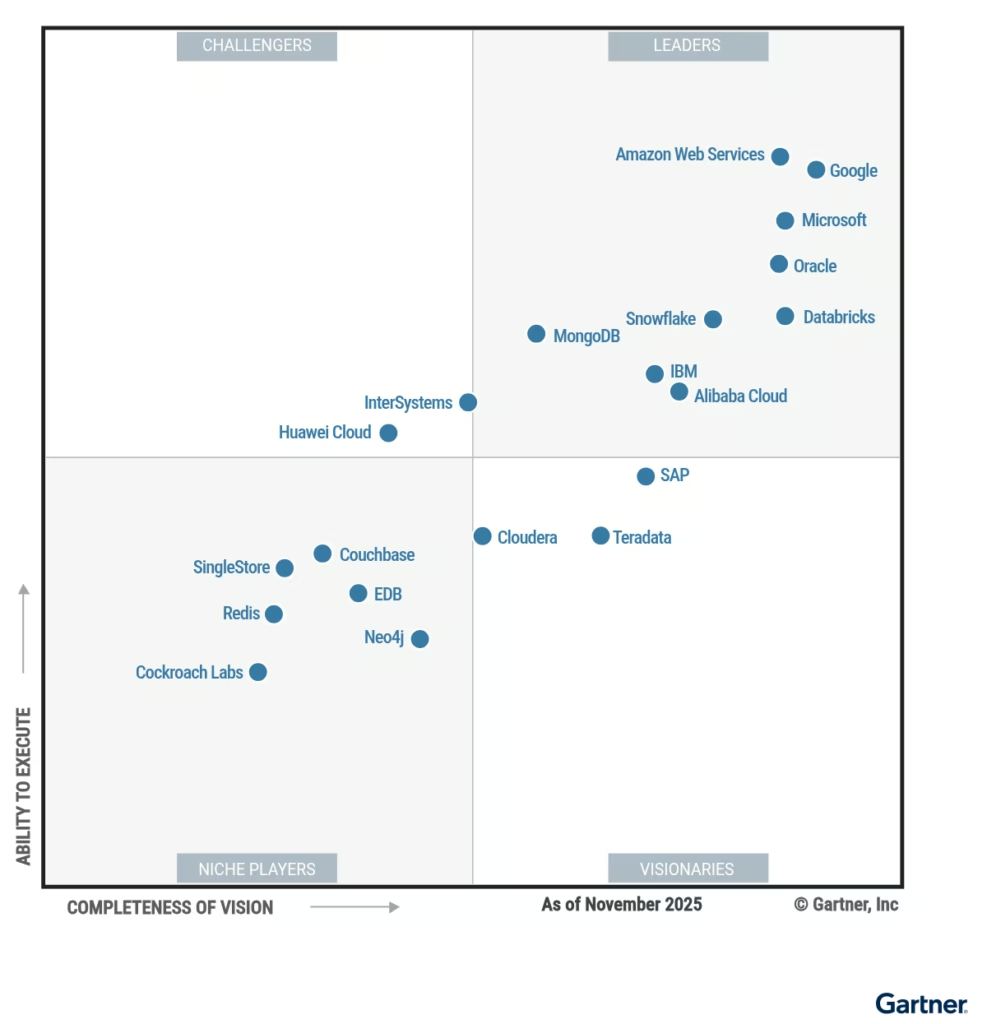
    Magic Quadrant for Cloud Database Management Systems, Source: Gartner, Nov 2025
    Magic Quadrant for Cloud Database Management Systems, Source: Gartner, Nov 2025

    DBMS market growth and trends

    The global DBMS market reached US$119.5 billion in 2024, growing 13.4% year-on-year. Gartner expects the industry to expand by 18.4% in 2026 to US$161 billion, driven by rising data volumes and growth of analytic workloads, AI adoption and cloud-native expansion.

    Organization across all industries are generating unprecedented amounts of data amid digital transformation initiatives, expanded online operations, and automation of business processes. This changing landscape requires scalable, cost-effective storage and processing solutions that traditional on-premise systems struggle to offer.

    At the same time, AI applications demand databases optimized for ML, real-time analytics, and predictive technologies, requiring architecture capable of efficiently handling massive scale, low-latency requirements, and vector operations.

    AI penetration in the enterprise is accelerating. An analysis by Andreessen Horowitz, based on internal data and conversations with corporate executives, found that 29% of the Fortune 500 and about 19% of the Forbes Global 2000 are now live, paying customers of a leading AI startup. This rapid adoption is notable because large corporations historically resist being early tech adopters and typically wait years before becoming customers.

    According to the research, enterprise adoption is currently dominated by specific use cases and industries. Coding, support, and search represent the lion’s share of use cases, while the tech, legal, and healthcare sectors are the industries most eager to adopt AI.

    Application of AI in the enterprise, Source: Andreessen Horowitz, Apr 2026
    Application of AI in the enterprise, Source: Andreessen Horowitz, Apr 2026

    In finance, AI usage is expanding rapidly, with 71% of the companies polled by KPMG in 2024 reporting the use of AI, and 41% utilizing it to a moderate or large degree.

    Companies are turning to AI in every area of finance. Accounting and financial planning are currently the furthest ahead, with nearly two-thirds of the respondents piloting or using AI for these functions. In these areas, organizations are aiming for benefits including improved data processing, financial reporting, real-time insights, and predictive analysis.

    Treasury and risk management follow suit, with nearly half of respondents piloting or using AI to improve debt management, cash-flow forecasting, fraud detection, credit risk assessment, and scenario analysis.

    Progress made in the use of AI in finance areas, Source: KPMG Global AI in Finance Report, 2024
    Progress made in the use of AI in finance areas, Source: KPMG Global AI in Finance Report, 2024


    Featured image: Edited by Fintech News Switzerland, based on image by arslantanoli via Freepik3

    Sponsored ReportThe Payments Intelligence GapRead
    Share. Facebook LinkedIn Twitter Telegram Copy Link Email

    Author

    fintech switzerland
    Fintechnews Switzerland
    • Facebook
    • X (Twitter)

    Related Posts

    Beacon Bank Taps Finastra to Simplify Payments After Its Merger

    November 17, 2026

    Alibaba Cloud Launches New Cloud Region in Amsterdam

    October 30, 2026

    Canada’s CIBC Taps Thought Machine for Retail Banking Overhaul

    October 30, 2026

    Vancity to Shift Core Banking onto Temenos SaaS

    October 27, 2026

    Temenos Cloud Now Supports Banking and Payments at Kingdom Bank

    October 23, 2026

    Google Cloud Restores London Services After Outage Hits UK Banks

    October 21, 2026

    Temenos to Modernise Sound Credit Union’s Collections with SaaS

    October 16, 2026

    Namespace Raises US$42M Series B to Expand Software Build Services

    October 7, 2026
    AI Sponsored

    81% of Financial Firms Use AI. Only 14% Call It Transformational

    October 21, 2026
    Fintech Newsletter
    Subscribe to the most important Fintech Switzerland News
    Follow Us
    • Facebook
    • X / Twitter
    • LinkedIn
    • Instagram
    Swiss Fintech Startup Directory

    Swiss Fintech Startup Directory

    Top Swiss Fintech Startups

    Top Fintech Startups in Switzerland for 2026

    Upcoming Fintech Events
    Country
    AI & Big Data Expo Global 2027
    February 3, 2027
    -
    February 4, 2027
    United Kingdom
    -
    London
    Digital Finance Summit 2026
    December 3, 2026
    Belgium
    -
    Brussels
    Digital Society 2026
    November 25, 2026
    Germany
    -
    Frankfurt am Main
    FIBE Berlin 2027
    April 7, 2027
    -
    April 8, 2027
    Germany
    -
    Berlin
    FINANZ 2027
    March 17, 2027
    -
    March 18, 2027
    Switzerland
    -
    Zurich
    Promote Event View More
    Whitepapers & E-Books
    The Future of Competitive Advantage in Banking & Payments
    The Future of Competitive Advantage in Banking & Payments
    Bottomline
    American Newsletter

    Fintech News America

    Australia Fintech Map

    Australia Fintech Map

    Philippines Fintech Report

    SINGAPORE FINTECH REPORT

    Singapore Fintech Map 2025

    Indonesia Fintech Report

    Indonesia Fintech Map 2025 banner

    UAE Fintech Report

    UAE Fintech Report 2024

    Free Business Accounts

    Navigation
    • About Fintech News Network
    • FNN Media Kit
    • Work With Us
    • Contact Us
    • Fintech Switzerland Newsletter
    • Submit Press Release
    • Submit Fintech Startup
    • Datenschutzerklärung / Impressum
    Other Fintech News Network Publications
    Fintech News Switzerland
    Fintech News Singapore
    Fintech News Malaysia
    Fintech News Hong Kong
    Fintech News Philippines
    Fintech News Network Indonesia
    Fintech News Network Australia
    Fintech News Baltic
    Fintech News Nordics
    Fintech News America
    Fintech News UAE
    Fintech News Africa
    Get Informed

    Subscribe to Updates

    Subscribe to the most important Fintech Switzerland News

    Facebook LinkedIn X (Twitter) Instagram RSS
    • About Fintech News Network
    • FNN Media Kit
    • Work With Us
    • Contact Us
    • Fintech Switzerland Newsletter
    • Submit Press Release
    • Submit Fintech Startup
    • Datenschutzerklärung / Impressum
    © 2015 - 2026 Copyright CK Finanzpro GmbH. All Rights reserved.

    Type above and press Enter to search. Press Esc to cancel.

    Fintech Schweiz Digital Finance News - FintechNewsCH
    Manage Consent

    Your Privacy Matters to Us

    To provide the best experiences, we use technologies like cookies to store and/or access device information. Consenting to these technologies will allow us to process data such as browsing behavior or unique IDs on this site. Not consenting or withdrawing consent, may adversely affect certain features and functions.

    Functional Always active
    The technical storage or access is strictly necessary for the legitimate purpose of enabling the use of a specific service explicitly requested by the subscriber or user, or for the sole purpose of carrying out the transmission of a communication over an electronic communications network.
    Preferences
    The technical storage or access is necessary for the legitimate purpose of storing preferences that are not requested by the subscriber or user.
    Statistics
    The technical storage or access that is used exclusively for statistical purposes. The technical storage or access that is used exclusively for anonymous statistical purposes. Without a subpoena, voluntary compliance on the part of your Internet Service Provider, or additional records from a third party, information stored or retrieved for this purpose alone cannot usually be used to identify you.
    Marketing
    The technical storage or access is required to create user profiles to send advertising, or to track the user on a website or across several websites for similar marketing purposes.
    • Manage options
    • Manage services
    • Manage {vendor_count} vendors
    • Read more about these purposes
    View preferences
    • {title}
    • {title}
    • {title}