


Close Menu
    • Top Fintech Startups in Switzerland
    • Switzerland Fintech Startup List
    • Virtual Banking
    • Open Banking
    • Online Mortgage
    • Regtech
    • Fintech Events
    • Submit Press Release
    • Submit Startup
    Facebook LinkedIn X (Twitter) Instagram RSS
    • About Fintech News Network
    • Media Kit
    • Contact Us
    • Work With Us
    • Newsletter
    • Submit Press Release
    • Submit Startup
    • Impressum
    Fintech Schweiz Digital Finance News – FintechNewsCH
    part of Fintech News Network

    Fintech News Network

    Facebook LinkedIn X (Twitter) Instagram RSS
    Free Newsletter
    • Blockchain
    • Wealthtech
    • Lending
    • Mobile Payments
    • Insurtech
    • PFM
    • AI
    • Funding
    • Various
      1. Germany
      2. London
      3. USA
      4. Austria
      5. Liechtenstein
      6. View All

      BaFin Fines Deutsche Bank €8 Million Over Postbank Migration Issues

      November 13, 2026

      Affirm Acquires Ratepay as Nexi Focuses on Core Activities

      November 10, 2026

      Eurex Clearing to Handle Digital and Traditional Assets Together

      November 4, 2026

      Deutsche Börse Extends Access to DAX 40 Stocks Beyond Xetra Hours

      October 28, 2026

      Payhawk Reaches US$2 Billion Valuation in Goldman Sachs-Led Series C

      November 20, 2026

      Griffin Raises US$20M to Add Card and Stablecoin Services

      November 13, 2026

      HSBC UK Launches Stripe-Powered Tap to Pay for Small Businesses

      November 12, 2026

      UBS Job Cuts Hit London as Credit Suisse Integration Enters Final Phase

      November 6, 2026

      Lauren Boyman Joins Broadridge from KPMG as Marketing Chief

      November 19, 2026

      Beacon Bank Taps Finastra to Simplify Payments After Its Merger

      November 17, 2026

      Wise Expands into US Investing via Its Broker-Dealer Licence

      November 16, 2026

      Anchorage Digital and Visa Add USDPT as a Settlement Option

      November 13, 2026

      Revolut Austria Banking Branch to Launch in 2027 With Local IBANs

      November 5, 2026

      BingX EU Secures MiCA Licence for Crypto Services in Europe

      October 15, 2026

      Bitget Pauses Withdrawals Following US$351.6M Hot Wallet Hack

      September 25, 2026

      Bybit Payments Secures Austria EMI License for European Payment Services

      August 5, 2026

      Swiss and Liechtenstein Banks Resist Core Banking System Overhaul

      November 11, 2026

      Swiss Blockchain Survey 2026: Banks on Stablecoins and Tokenized Funds

      October 20, 2026

      Bank Frick Enables Real-Time Euro Transfers and CHF Payment Receipts

      July 21, 2026

      Celsion Bank Begins Operations, Combining Digital Assets and Traditional Banking

      April 10, 2026

      Lauren Boyman Joins Broadridge from KPMG as Marketing Chief

      November 19, 2026

      Top Finfluencers in Switzerland in 2026

      November 10, 2026

      88% of Tech Founders Walk Away with Zero Exit Value

      November 9, 2026

      MUFG Bank Europe Absorbs Securities Arm to Become EU Universal Bank

      November 4, 2026
    • More
      • Fintech Events
      • Top Swiss Fintechs in 2026
      • Swiss Fintech Startup List
      • Accelerators
    Fintech Schweiz Digital Finance News – FintechNewsCH

    Fintech News Network

    Home»Various»Fintech: Banks, Beware! Why Banks Have a Difficult Time Innovating
    Various

    Fintech: Banks, Beware! Why Banks Have a Difficult Time Innovating

    Christian Hugo HoffmannChristian Hugo HoffmannJanuary 22, 20206 Mins Read
    LinkedIn Facebook Twitter Telegram Copy Link Email
    Fintech: Banks, Beware!
    Share
    Facebook Twitter LinkedIn Telegram Copy Link Email
    Free Newsletter

    Get the hottest Fintech Switzerland News once a month in your Inbox

    The birth and rise of Fintech is deeply rooted in the global financial crisis of 2008, particularly the erosion of trust it generated. People’s anger at the banking system was the ideal breeding ground for genuine financial innovation.

    In four simple words, fintech expresses “Power to the People”. Take money transfers, for example. By allowing transparency and cutting middlemen fees, fintech startups empower individuals to have control over their own money.

    Such examples pose a number of obstacles which banks need to overcome to get fit and ready for the digital era. In the following, we portray some innovator’s dilemmas and problems, but also show that small and medium-sized banks that are at a disadvantage at first sight do not need to fall behind. Instead, on the contrary, they could easily become partners in great demand as well as key beneficiaries.

    Bottomline

    Why banks have a difficult time innovating

    Even though it is a commonplace that banks are able to innovate – simply because they proved it, otherwise they would have been out of business long ago – subtle observations provide evidence that they face some severe complications on the way, at least in recent times. We would like to point to the following:

    • At first glance, one would expect fintech leadership from established banks since they regularly spend substantial amounts on IT. Yet, a closer look reveals that investments in that area are not only growing modestly over time, but first and foremost the lion’s share is spent on the maintenance of existing legacy systems.
    • In many cases, their business culture values tradition, consistency, reliability, predictability, and short-term profitability.
    UBS Bank | image via Unsplash
    • These values have served the banks very well in the past, as demonstrated by their self-conception which ranges between confidence and arrogance, but those values are ill-suited to a marketplace which is being radically transformed by digitization and which, therefore, requires the ability to respond quickly.
    • Most activities which banks undertake take too long and cost too much. True innovation stems from experimentation, and it ought to be acceptable that the outcome of some experiments may be not to go ahead. Without the Popperian trial-and-error, it could mean that innovation efforts are remaining too conservative and not sufficient risks are being taken. Accounting for costs as well as duration are also fundamental needs, but if it then follows that most things are too slow and too expensive, then failure becomes unaffordable at the expense of innovation.

    The best way to understand if customers wish for certain innovations is to equip them with a foretaste of what is to come. That is to create a prototype that, as far as possible, looks and feels like the end product to the customer. The non-customer-facing backend, though, can sometimes be implemented less rigorously. By embracing this procedure of prototype testing, of strengthening frontend tools and adopting a multi-channel approach, which goes hand in hand with short feedback cycles, banks can get a handle on a main game-changer, namely customer experience, which is set to influence the future development of the financial industry tremendously. If they happen to miss this chance, the elephant in the room is that incumbent banking systems become completely bypassed or that incumbents come to be perceived as utilities only.

    The utilities risk

    The proliferation of niche players specializing in certain services makes it more and more difficult for traditional financial institutions to keep ownership of their customers or the customer relationship. In other words, a major risk for incumbents is that they will do little more than supply the (basic) infrastructure for the provision of financial services while more agile, lean and customer-oriented fintech challengers or fintech startups that are not constrained by legacy IT systems take over banks’ front office, and thus will own the customer relationship.

    Fintech for SMEs

    In light of those risk factors, small and medium-sized enterprises (SMEs) in the banking landscape, the anchor point of the Swiss economy, are the key beneficiaries of disruptive startups. We see at least four reasons for that:

    • SMEs’ pressure to catch up with the market leaders is very high; e.g., in Switzerland, UBS and CS set the standard for applying cutting-edge new technologies such as Artificial Intelligence (AI) and Machine Learning (ML) in banking.
    • Their needs are less complex and, thus, more easily addressed by early stage-companies that do not have the resources to tackle complex problems for receiving first feedback from the market.
    • SMEs rely on outsourcing expertise, not least because their talent pools are much shallower than those of large enterprises.
    • They are willing to try novel tools which will have a tangible, substantial impact on their business.

    This reasoning suggests a positive outlook for SMEs in an environment where, we would further argue, the importance of connecting established financial services players and young fintech firms via Application Programming Interfaces (APIs) stands out.
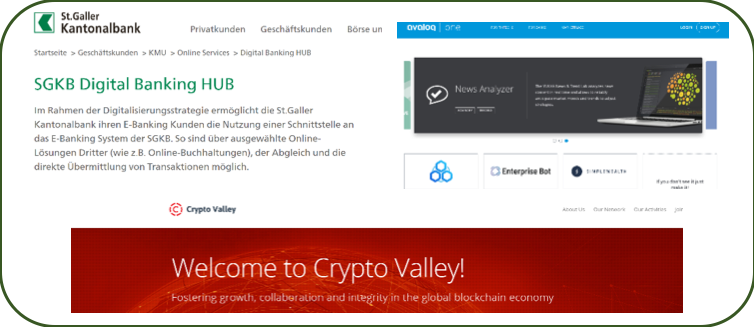
    Figure 2: Three different Swiss examples that point to the future of (namely, open) banking. SGKB offers interfaces to make third-party services accessible to their customers without abandoning the customer relationship. Avaloq.one, behind one of the Swiss leaders in core banking software, operates a platform that encompasses a number of fintechs.And thirdly, Crypto Valley Zug constitutes a role model of a knowledge ecosystem around crypto and blockchain solutions.

    Disrupted, reimagined.

    You know what common sense says: if you can’t beat them, join them. The best move for financial institutions, be they small or large, is to collaborate, not to compete – and many banks, cultivating an open innovation mind-set, have understood this. In this context, different scenarios can be envisioned. In its report entitled “The Future of Fintech and Banking: Digitally disrupted or reimagined?”, Accenture details what it considers to be the most likely ones.

    Scenario 1: banks continue to believe in the appeal and efficacy of their old business mantras and fail to adapt to the digital era, hence getting marginalized by new players.

    Scenario 2: they appreciate the importance of customer experience, act accordingly, and embrace open innovation, mainly working together with new entrants, e.g. in the sense of establishing a connected API economy. The second option, especially in the wake of the upcoming supremacy of business ecosystems (over industry sectors and single corporations) or regulatory measures such as the PSD2 directive, appears far more likely, now that banks are laying their cards on the table, which, we hope, will result in many win-win situations.


    Featured image credit: Unsplash

    Sponsored ReportThe Payments Intelligence GapRead
    Share. Facebook LinkedIn Twitter Telegram Copy Link Email

    Author

    Avatar photo
    Christian Hugo Hoffmann
    • Website

    Prof. Dr. Christian Hugo Hoffmann is Assistant Professor for Finance, Cryptocurrencies and Fintech at the University of Liechtenstein (as of Feb 2020) as well as Senior Consultant at indivio AG in Zurich. Apart from that, he co-founded two fintechs, serves as director of Startup Grind Geneva, is a member of the Swiss Fintech Innovation Lab at UZH as well as of the Consultative Expert Group on Digital Ethics at the European Insurance and Occupational Pensions Authority (EIOPA), and regularly writes pieces on AI in leading magazines and newspapers such as NZZ, Schweizer Monat and Towards Data Science.

    Related Posts

    Lauren Boyman Joins Broadridge from KPMG as Marketing Chief

    November 19, 2026

    Top Finfluencers in Switzerland in 2026

    November 10, 2026

    88% of Tech Founders Walk Away with Zero Exit Value

    November 9, 2026

    MUFG Bank Europe Absorbs Securities Arm to Become EU Universal Bank

    November 4, 2026

    Swiss Officials Weigh the Costs of a UBS Relocation Abroad

    October 30, 2026

    Lagarde to Step Down as ECB President on 7 February 2027

    October 30, 2026

    Top 9 Emerging Fintech Providers from Europe

    October 28, 2026

    Swiss UBS Job Cuts Could Grow by Up to 12,000, Bank Union Warns

    October 26, 2026
    AI Sponsored

    81% of Financial Firms Use AI. Only 14% Call It Transformational

    October 21, 2026
    Fintech Newsletter
    Subscribe to the most important Fintech Switzerland News
    Follow Us
    • Facebook
    • X / Twitter
    • LinkedIn
    • Instagram
    Swiss Fintech Startup Directory

    Swiss Fintech Startup Directory

    Top Swiss Fintech Startups

    Top Fintech Startups in Switzerland for 2026

    Upcoming Fintech Events
    Country
    AI & Big Data Expo Global 2027
    February 3, 2027
    -
    February 4, 2027
    United Kingdom
    -
    London
    Digital Finance Summit 2026
    December 3, 2026
    Belgium
    -
    Brussels
    Digital Society 2026
    November 25, 2026
    Germany
    -
    Frankfurt am Main
    FIBE Berlin 2027
    April 7, 2027
    -
    April 8, 2027
    Germany
    -
    Berlin
    FINANZ 2027
    March 17, 2027
    -
    March 18, 2027
    Switzerland
    -
    Zurich
    Promote Event View More
    Whitepapers & E-Books
    The Future of Competitive Advantage in Banking & Payments
    The Future of Competitive Advantage in Banking & Payments
    Bottomline
    American Newsletter

    Fintech News America

    Australia Fintech Map

    Australia Fintech Map

    Philippines Fintech Report

    SINGAPORE FINTECH REPORT

    Singapore Fintech Map 2025

    Indonesia Fintech Report

    Indonesia Fintech Map 2025 banner

    UAE Fintech Report

    UAE Fintech Report 2024

    Free Business Accounts

    Navigation
    • About Fintech News Network
    • FNN Media Kit
    • Work With Us
    • Contact Us
    • Fintech Switzerland Newsletter
    • Submit Press Release
    • Submit Fintech Startup
    • Datenschutzerklärung / Impressum
    Other Fintech News Network Publications
    Fintech News Switzerland
    Fintech News Singapore
    Fintech News Malaysia
    Fintech News Hong Kong
    Fintech News Philippines
    Fintech News Network Indonesia
    Fintech News Network Australia
    Fintech News Baltic
    Fintech News Nordics
    Fintech News America
    Fintech News UAE
    Fintech News Africa
    Get Informed

    Subscribe to Updates

    Subscribe to the most important Fintech Switzerland News

    Facebook LinkedIn X (Twitter) Instagram RSS
    • About Fintech News Network
    • FNN Media Kit
    • Work With Us
    • Contact Us
    • Fintech Switzerland Newsletter
    • Submit Press Release
    • Submit Fintech Startup
    • Datenschutzerklärung / Impressum
    © 2015 - 2026 Copyright CK Finanzpro GmbH. All Rights reserved.

    Type above and press Enter to search. Press Esc to cancel.

    Fintech Schweiz Digital Finance News - FintechNewsCH
    Manage Consent

    Your Privacy Matters to Us

    To provide the best experiences, we use technologies like cookies to store and/or access device information. Consenting to these technologies will allow us to process data such as browsing behavior or unique IDs on this site. Not consenting or withdrawing consent, may adversely affect certain features and functions.

    Functional Always active
    The technical storage or access is strictly necessary for the legitimate purpose of enabling the use of a specific service explicitly requested by the subscriber or user, or for the sole purpose of carrying out the transmission of a communication over an electronic communications network.
    Preferences
    The technical storage or access is necessary for the legitimate purpose of storing preferences that are not requested by the subscriber or user.
    Statistics
    The technical storage or access that is used exclusively for statistical purposes. The technical storage or access that is used exclusively for anonymous statistical purposes. Without a subpoena, voluntary compliance on the part of your Internet Service Provider, or additional records from a third party, information stored or retrieved for this purpose alone cannot usually be used to identify you.
    Marketing
    The technical storage or access is required to create user profiles to send advertising, or to track the user on a website or across several websites for similar marketing purposes.
    • Manage options
    • Manage services
    • Manage {vendor_count} vendors
    • Read more about these purposes
    View preferences
    • {title}
    • {title}
    • {title}