



In Europe, manipulative design practices, addictive application features, and finfluencer-driven promotion of risky or misleading financial products, are widespread, according to a new study by Finance Watch, an independent European non-governmental organization (NGO) serving as a public-interest counterweight to private financial lobbies.
These methods benefit financial institutions by undermining customers’ ability to make clear, informed, and free decisions, prompting calls for legislative action.
The study, conducted by the Behaviouralist, examined 24 financial institutions’ websites and mobile applications across four European Union (EU) countries from April to June 2026. It found extensive use of so-called dark patterns and addictive features designed to spur impulsive decisions and exploit cognitive biases.

Dark patterns, also known as deceptive user experience (UX) patterns, are design tactics that trick online users into making choices that aren’t always in their best interest. In the context of financial services, these practices can mislead consumers into making investment decisions that result in significant financial detriment, in particular for vulnerable consumers, but which are beneficial to the company.
Most prevalent manipulative design tactics
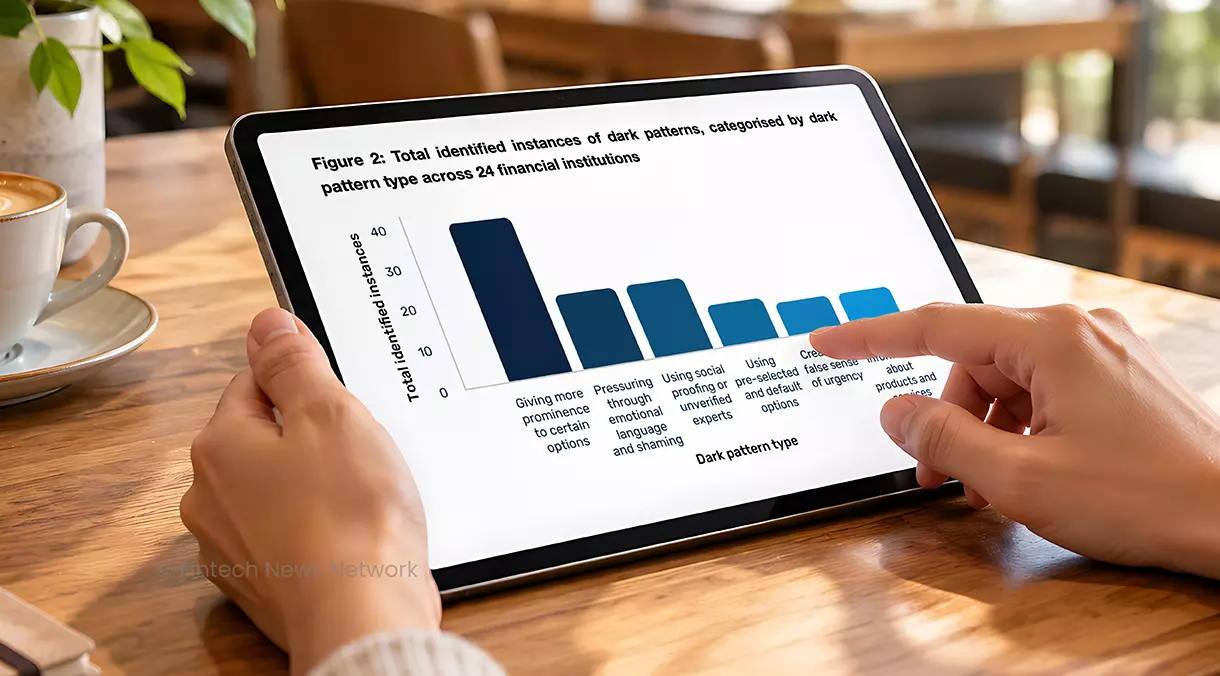
The study found that among financial institutions’ websites and apps, the most prevalent manipulative design feature involved giving more prominence to certain options when asking consumers to make choices, observed in 40 instances across the 24 financial institutions.
This type of dark pattern is typically used to guide customers towards the option that is most beneficial to the firm but not necessarily in the interest of the consumer.
One particular example used lists of trending investment products on the user interfaces, ranking assets according to predefined criteria, thereby directing users’ attention towards specific options. Another example involved the use of recommendation features to give more prominence to an option the firm wants the consumer to choose, like a higher-fee generating product, identified in 19 instances across the sample.
The use of emotional language and shaming to nudge consumers towards a particular decision was another prominent manipulative design feature in the sample, with 19 instances observed.
A popular technique here was the use of loss-aversion framing through banners shaming users into investing in a particular retail investment product by pointing out that they would lose out otherwise.
Examples included statements, such as “Did you know that money can lose value?” and that “inflation will erode purchasing power”, positioning investment as a way to avoid this loss. An interactive calculator would sometimes be displayed projecting users’ losses from non-investment, effectively shaming consumers into taking action.
Financial institutions also relied on the use of social proofing and misrepresentations or unverified expert or institutional opinions, tactics observed 19 times in the sample. Examples included misleading analyst recommendations, star ratings, or fake “expert” commentary designed to reduce users’ critical evaluation of investment decisions because they come from a perceived authority.
In particular, the study identified instances of analyst recommendations without context, creating a particularly strong authority bias effect by removing uncertainty and caveats that would support more balanced decision-making.
Another troubling example was a page featuring investment ideas, among them supposedly from famous investors such as Warren Buffett or Bill Gates. These features appeal to consumers’ behavioral biases, prompting them to invest in the options presented, despite those options being only loosely related to these famous investors.
Pre-selected or default options appeared in 11 instances, mostly in trading apps, while obscuring important product information, such as key details about risks, was seen in nine cases. These are designed to limit consumers’ ability to make informed decisions and raise the chance of buying an unsuitable product or making an unsuitable investment.
Another frequently observed dark pattern, identified in nine instances as well, was the use of design features that create a false sense of urgency, such as time-limited offers, countdown timers, and urgency-inducing deadlines. These aim to pressure users to make investment decisions more quickly than they otherwise would.

Addictive design features and the role of finfluencers
The study also found that financial institutions in the EU relied on addictive design features to exploit psychological vulnerabilities, extend user engagement, and drive compulsive behavior.
In particular the use of live retail investment product performance updates in firms’ mobile apps was identified in 19 instances, nudging users towards executing an impulsive trade and exploit investors’ cognitive bias.
The research also examined finfluencer practices, examining content traits, key messages, risk communication, disclosure of ties to financial providers and monetization, and behavioral techniques. It covered 15 financial influencers from Spain, Germany, Hungary, and Czechia with substantial audience reach and visibility based on country-specific rankings, follower counts and platform engagement metrics.
Roughly 54% of the 59 individual pieces of finfluencer content analyzed were presented as educational in nature rather than as advertisements. Many finfluencers in the sample even went so far as claiming to teach financial knowledge that schools and traditional institutions do not provide.
Yet, none held a formal financial advisory license or regulated credential, nor did any explicitly present themselves as a “certified financial adviser.” Instead, creators tended to rely on personal investment experience, claims of entrepreneurial success, references to books or mistakes they had learned from, citations of well-known investors, and references to media or “financial experts”.
This carries high risk for consumers because most of these influencers lack the competence to speak about finance and many have commercial interests in the products they are talking about.
One concerning pattern among these finfluencers was the use of social media content to funnel audiences into private or paid spaces, such as Patreon, Discord, online courses, academies and membership programs, where consumers are told they will receive financial education lessons.
Inside these private, paid communities, the messages provided may be advertising instead of purely educational and may even constitute investment advice. In the worst case, these offers marketed as “educational” can turn out to be outright scams.
In the US, a social media influencer was sentenced to six years in prison in April 2026 for orchestrating a US$20 million real estate Ponzi scheme and committing tax fraud to further that scheme. He promoted the investments, often promising a rate of return of 30% or more, through social media, especially Facebook and YouTube.
In the UK, a coordinated week of action on finfluencers in June 2025 involved nine international regulators and resulted in three arrests, six criminal proceedings, 11 targeted warning or cease-and-desist letters, 50 warning list alerts and 650 social media takedown requests.
Addressing malpractices
These findings indicate that while the digitalization of the retail financial services market offers important opportunities, such as ease of access to services, it also introduces new risks that can erode trust in capital markets and the financial sector more broadly.
In this context, Finance Watch proposes a set of policies suited to the upcoming Digital Fairness Act (DFA) in the EU. It suggests a general prohibition of misleading design features that influence consumer choices, such as dark patterns, in the Unfair Commercial Practices Directive (UCPD), and calls for prohibiting common forms.
It also suggests requiring firms to disable by default any feature that might trigger addiction-like behavior, such as excessive push notifications in the UCPD, and to prohibit finfluencer advertising and marketing of retail investment products.
Finally, it recommends mandatory registration and licensing for financial influencers who teach financial literacy skills. These licensing rules should include basic competency standards, such as financial knowledge, along with record-keeping duties to support supervision and enforcement.
Over the past years, dark patterns have spread widely in the EU, with 97% of the 75 most popular websites and apps used by consumers in the region deploying at least one, according to a report by the European Commission. Common types include hidden information or false hierarchy, preselection, nagging, difficult cancellations, and forced registration.
Featured image: Edited by Fintech News Switzerland, based on image by Sketch Graphic via Magnific