


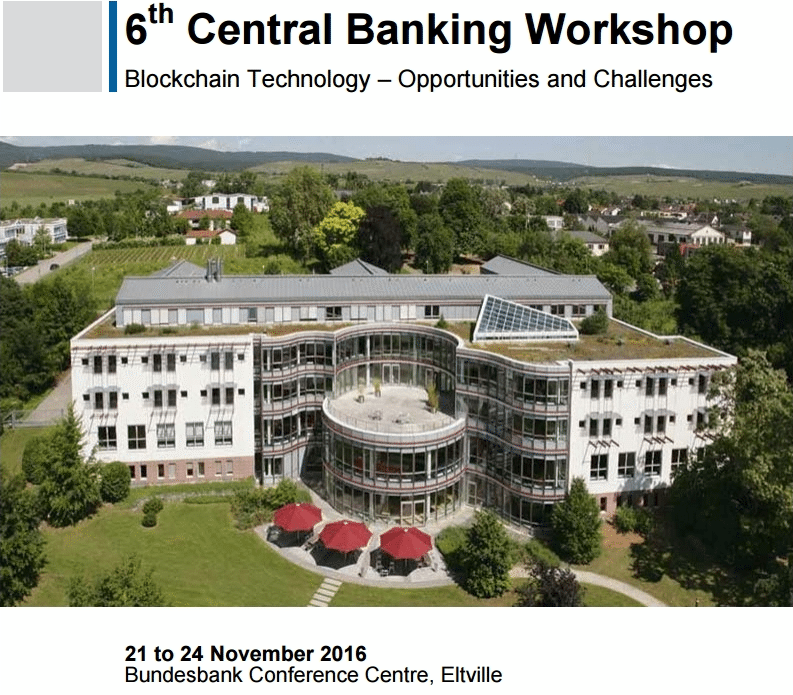
Keynote Speech at the 6th Central Banking Workshop 2016 by Carl-Ludwig Thiele, Member of the Executive Board of the Deutsche Bundesbank.
Introduction
I would like to warmly welcome you to the 6th Central Banking Workshop. I am delighted that we have been able to attract such top-class speakers and participants to this event, who, given their experience and knowledge, are able to provide valuable contributions on what is a highly topical subject. This year, the workshop is about blockchain technology, which has generated a large swell of public interest, or even hype, one could say.
With our workshop, entitled “Blockchain technology – opportunities and challenges“, we want to enable a lively exchange between researchers, practitioners and regulators. Each of these groups, in its own right, has a keen interest in this topic. But, as Ernst Ulrich von Weizsäcker once said: “An exchange of views requires people to talk to each other, not about each other”. In this spirit, I hope that we will have a stimulating exchange of views over the coming days.
Blockchain technology is currently generating almost exuberant enthusiasm among banks, enterprises and public bodies. New initiatives and cooperation agreements on blockchain applications are being announced in the financial press on a near daily basis. This is not limited solely to banks and private enterprises, but also encompasses projects by governments and central banks.
Examples of such cooperation agreements can be found on all of the world’s continents. Beside Fintechs and other startups, participants include the Bank of England, stock exchanges in the United States, Australia and Japan, as well as numerous commercial banks, to name only a few. Even an aircraft manufacturer, Airbus, is exploring blockchain for the purpose of process optimisation.
Structure and Objectives of The Workshop
How is it that a relatively complicated form of technical processing is generating such enthusiasm?
In this workshop we want to address this question by talking about the possibilities that blockchain technology opens up and the challenges this presents.
This is anything but a trivial undertaking. Indeed, views on these possibilities and challenges vary greatly from person to person, but also among institutions. At present, there is no telling whether blockchain will supersede existing technology in a few years’ time. All the more reason, therefore, is to examine this technology and its implications in detail and gather key insights about it. This is true, not least, for central banks and regulators. So what lies behind this technology?
Even when it comes to a basic definition, we see that the word blockchain is not always used to mean the same thing. Often, the term “distributed ledger technology” is used as a synonym for blockchain. If we regard distributed ledger technology as the principle behind distributed databases, blockchain represents a sub-category thereof. However, there is, as yet, no uniform definition of the term.

An elementary understanding of the technology is a prerequisite for discussing its potential, which is why module 1, entitled “Blockchain – basics, technological achievements and general potential”, is dedicated to this question.
Blockchain became known, above all, as the technology behind the bitcoin cryptocurrency. The term is derived from the fact that transactions are grouped together in “blocks”. These blocks are chained together through a complex mathematical procedure that is unforgeable and tamper-proof.
Essentially, blockchain allows a ledger of transactions to be run on a decentralised basis within a network. The technology therefore enables the safe transmission of all manner of assets (not just bitcoin), without the need for confirmation from a central institution. With blockchain, reconciliation between participants occurs automatically. But what are we to do with this technical innovation?
Plato once said that: “Necessity is the mother of invention“. But in the case of blockchain, we are seeing the exact opposite. The invention, ie blockchain, has already been born. Now people in many places are searching for the necessity – for the specific cases where it can be applied in practice.
Blockchain-based technologies offer up the chance of simplifying complex intermediation processes for payment and settlement activities. Virtually all payment service providers are therefore currently looking for ways to apply this technology. Its use in payment transactions is an obvious choice, as the cryptocurrency bitcoin has already been created for this purpose.

But does it make sense to use blockchain in this of all areas? And in what form should it be used in the area of payment transactions? These questions will be addressed in module 2 of the workshop: “Possible business cases for payments”.
Payment transactions based on blockchain inevitably also raise the question of virtual currencies. Bitcoin was created shortly after the outbreak of the financial crisis and was intended to serve as a countermodel to the prevailing financial system. At first, bitcoin fired many people’s imagination and led some to expect a revolution in the financial system. It seemed conceivable that banks or even central banks could be bypassed and that a genuine “gold standard” could be created, based on bitcoin and independent of politicians and central banks. In addition to bitcoin, over 700 other virtual currencies have been created. However, none of these virtual currencies have managed to move beyond a niche existence.
The blockchain used to transmit bitcoins needs to be considerably altered to make it suitable for financial transactions. It is unclear whether the core problems of blockchain in terms of performance, scalability and security can be solved to allow a broad market rollout.
The question of the future of bitcoin and digital currencies in general will be examined in more detail in module 3: “Bitcoin – a promising alternative for payments?”

It is interesting to see how the public debate has developed since the early days of bitcoin. Efforts are now centred on evolving blockchain into a basic technology capable of facilitating allocation processes across companies. The potential users of this technology are often precisely those institutions which the creation of bitcoin was originally designed to make superfluous.
In addition to its application in payment transactions, numerous blockchain-based applications are being developed for securities settlement. Possible advantages from the use of blockchain technology arise not only from the technology itself, but also through process optimisation and potential disintermediation in this area.
Securities settlement has improved considerably in recent years, especially in Europe. However, this development is not yet complete, as the settlement landscape remains complex and is characterised, in part, by convoluted processes. Although we trade securities within nanoseconds, we need several days to settle these transactions.
We will take a closer look at securities settlement in module 4, entitled “Possible applications and its potential in the post-trade industry“.

These numerous questions and potential radical changes on the financial markets present us, as a central bank, with particular challenges – in payment transactions, securities settlement and beyond. The workshop therefore focuses on the special role of central banks in module 5, entitled “Blockchain – a central bank perspective“.
As a central bank, we are faced with the question of how to deal with blockchain technology. In settlement, we are affected in two ways. As an operator of central payment and securities settlement systems, we also need to think about the future development of these infrastructures, despite the high performance systems already in existence. Blockchain-based technologies must be integrated in such a way that they provide added value. Indeed, as entrepreneur and politician Philip Rosenthal once said: “He who ceases to be better, ceases to be good“.
From the perspective of oversight, we need to keep a careful watch on current developments and intervene if necessary. A deep technical understanding is necessary in order to respond appropriately to new business models from a regulatory perspective.
The two decisive criteria that we need to measure distributed ledger and other new technologies by are the following.
– First, does using the new technology improve the security of the systems or at least not make it worse?
– And second, does the use of new technologies increase the efficiency of financial market infrastructures?
Current Developments and Outlook
Many enterprises and institutions currently working on blockchain-based solutions expect to reap great benefits from them. Blockchain technology holds out the promise of cost savings, de-risking potential and efficiency gains. This includes, among other things, the automation of work-sharing processes as well as faster processing and the fulfilment of contractual obligations via smart contract solutions.
One positive effect that can already be seen is industry-wide cooperation. Dialogue between various market participants on future market developments can foster mutual understanding and facilitate the harmonisation of processes. This makes it possible to adequately react to the challenges posed by new technologies. This is of importance in the financial industry, in particular, which is characterised by network effects.

That said, one should not simply gloss over the challenges and weaknesses posed by the technology.
The requirements imposed on regulated providers cannot currently be met by blockchain technology, or can only be met with difficulty. This concerns, for example, the question of how to engineer absolute finality. Furthermore, the know-your-customer requirements need to be observed and the confidentiality of transaction data must be ensured. This is also a reason why the regulatory status of blockchain technology in many countries is still unclear.
Furthermore, despite the supposedly greater resilience of its decentralised structure, blockchain still has high obstacles to surmount before it can be applied across the board, owing to its susceptibility to manipulation. Recent hacker attacks are a case in point.
This is another reason why the debate has largely shifted from open blockchain applications, such as bitcoin, to closed networks with a limited circle of participants.
Conclusion
Inefficiencies are often perpetuated not by a lack of technology, but by (historical) structures. Blockchain technology is therefore not a patent solution for change, but it does provide an opportunity to make change.
Disruptive technologies require time to develop, mature and unfurl their full potential. Not every innovation succeeds, though, and it remains to be seen how the application of blockchain technology will develop.
Following the revolutionary beginnings with bitcoin, the prevailing view now seems to be that blockchain applications will spread rather more gradually. One might therefore speak of evolution rather than revolution. Before we can even ask questions about the broader use of this technology, we must first be sure that using this new technology is at least as secure, efficient and cost-effective in financial transactions as conventional technology.

Blockchain technology could become a game changer, in the financial industry and, perhaps in particular, beyond. The potential of blockchain technology is often compared to that of the internet. It should be remembered that it took some time before the truly beneficial applications of the internet emerged. With blockchain, we are only at the very beginning of a potential development of this kind.
Innovations are the lifeblood of a continually developing economy. Moreover, evolution processes are never linear. The first great wave of euphoria, which was also seen in the media, is being followed by a phase of checking, weighing-up and consolidation, before new offers and technologies are rolled out on a broad scale.
Ladies and gentlemen, Goethe once said: “We know accurately only when we know little; with knowledge doubt increases.”
My impression is that with the increasing efforts being devoted to blockchain technology, doubts will also increase as to whether this technology can meet the expectations being placed on it, which in some cases are extremely high. The question that we want to examine in more detail in this workshop is what specific doubts we have and whether the technology can overcome them.
I would like to conclude by wishing you all an interesting and, above all, informative workshop.
Thank you very much for your attention.
About Carl-Ludwig Thiele