81% of Financial Firms Use AI. Only 14% Call It Transformational
Huawei’s Fintelligent AI Solution brings together agent development, data and knowledge, and AI operations to help banks build and evolve their own AI capabilities.
Get the hottest Fintech Switzerland News once a month in your Inbox
How much control does a bank really have over the AI it uses?
Let’s picture a relationship manager reviewing a credit memo drafted by an agent.
Before relying on it, the banker first needs to know which customer records informed the assessment and whether the agent used the current lending policy.
And once other departments start building their own agents, keeping track of them becomes a job in itself.
As adoption spreads, teams may duplicate work, rely on different policy versions and struggle to track costs across departments.
Managing that work across departments is part of what Huawei aims to address with its Fintelligent AI Solution, which provides a shared foundation for developing and operating agents.
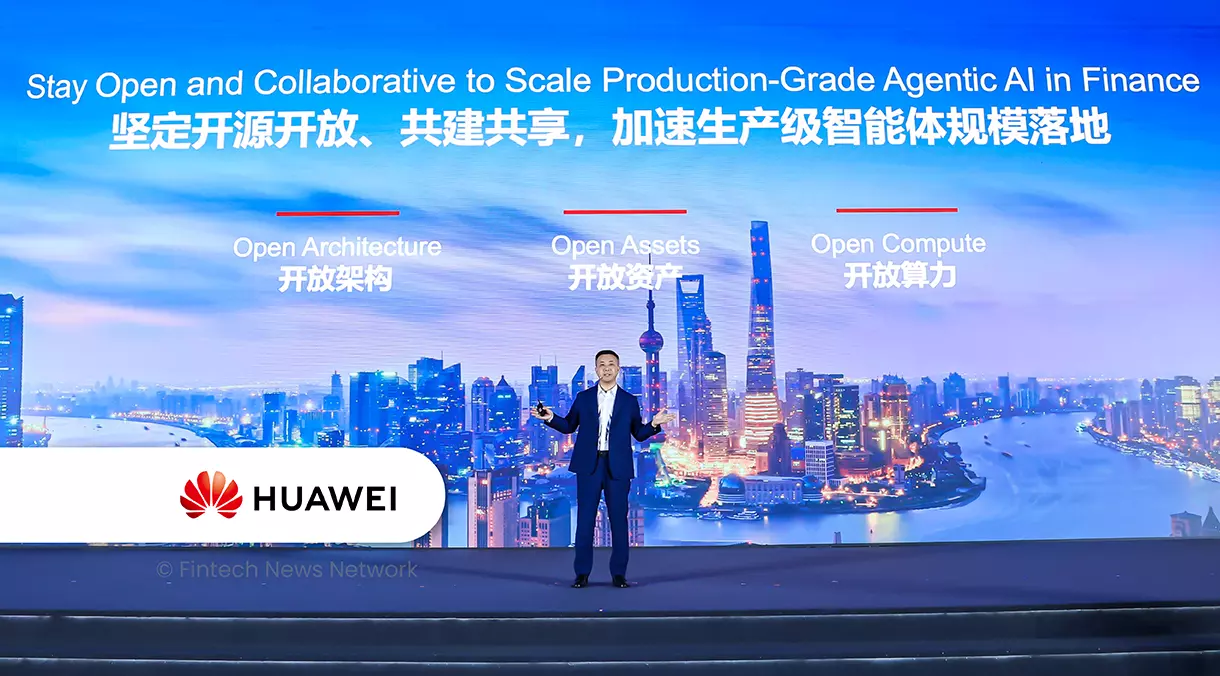
Huawei launched the solution at the Global Finance Summit during HUAWEI CONNECT 2026 in Shanghai on 18 September 2026.
Jason Cao, CEO of Huawei Digital Finance BU, presented Fintelligent as a way for banks to retain control over how they develop and use AI, explaining the thinking behind it in the company’s launch announcement.
Jason Cao
“Every financial institution should own its AI and keep the choice and evolution of AI in its own hands.”
For a bank, this means retaining meaningful choice over its AI architecture and models, building reusable knowledge and agent assets, and maintaining the ability to operate and improve them over time.
Huawei’s approach includes making the agents and knowledge developed within a bank available for other teams to reuse.
Fintelligent connects these capabilities through an open hybrid AI architecture and three factories: Agent Factory, Token Factory and Data-Knowledge Factory.
Managing Agents Across the Bank
Cambridge’s 2026 research found that 81% of surveyed financial-services firms were adopting AI at some level, although just 14% considered it transformational to their organisational strategy and competitive advantage.
As an industry example, DBS’s credit-memo tool supports about 1,500 employees worldwide and handles more than 70 tasks associated with preparing the documents.
Relationship managers and credit risk managers review the drafts and remain responsible for the final memo.
Banks running these applications across departments need to establish who owns each agent and which systems it can access.
Huawei’s Agent Factory is built around openJiuwen, an open-source agent platform that provides a shared foundation for banks to develop, run, manage and govern agents.
openJiuwen supports banks in creating an Agent Marketplace where departments can share and reuse agents and skills developed across the institution.
Under the Monetary Authority of Singapore’s (MAS) AI risk guidelines, issued on 7 October 2026, financial institutions remain accountable for AI used in their services even when an outside provider supplies the technology.
MAS expects institutions to maintain inventories of their AI use and apply proportionate controls, including human oversight.
Institutions should meet the expectations in Sections 3–4 from 7 October 2027, and those in Sections 5–6 by 7 October 2028.
Managing the Cost of AI at Scale
Preparing a due diligence report can involve processing lengthy documents, whereas a banker checking an account detail during a customer conversation needs a quick response, making the choice of model and computing resources dependent on the job.
Huawei’s Token Factory solution, TokeNexus, supports token planning, production, scheduling and optimisation to help banks manage AI operating costs, performance and capacity.
Tokens are units of content processed by AI models.
Huawei describes both public-cloud and on-premises options, allowing banks to consider deployment approaches against their workload, security and performance requirements.
Credit teams assessing the return could compare the cost of producing a memo with the time saved on preparation, accounting for the hours bankers still spend reviewing and correcting the draft.
Keeping Agents Aligned with Bank Knowledge
Policy updates need to reach agents as well as staff, because an agent working with an older document could apply rules the bank has already replaced.
Huawei’s Financial Agentic Data Solution, part of its Data-Knowledge Factory, supplies financial agents with data and knowledge drawn from institutional records, documents and rules.
Its pipelines are intended to keep supplying relevant material as the bank’s information changes.
Huawei also describes a path towards agent-assisted fraud operations, where investigators’ experience can be captured as reusable knowledge to support case analysis and rule refinement as fraud patterns evolve.
Preserving Business Rules in Legacy Systems
Business rules embedded in a bank’s software can determine how it assesses a customer’s loan, so developers need to preserve that logic when they replace the application.
Huawei’s AI Coding Solution helps them extract those rules as structured knowledge they can use in the replacement software.
Extracting those rules can help developers preserve business knowledge during modernisation, while the replacement application still requires validation.
These operational questions give practical meaning to owning AI.
The test is whether a bank can choose its technology, retain its business knowledge and keep improving its capabilities as adoption grows.
Featured image: Edited by Fintech News Singapore based on an image by Huawei via its Press Release.
To provide the best experiences, we use technologies like cookies to store and/or access device information. Consenting to these technologies will allow us to process data such as browsing behavior or unique IDs on this site. Not consenting or withdrawing consent, may adversely affect certain features and functions.
Functional
Always active
The technical storage or access is strictly necessary for the legitimate purpose of enabling the use of a specific service explicitly requested by the subscriber or user, or for the sole purpose of carrying out the transmission of a communication over an electronic communications network.
Preferences
The technical storage or access is necessary for the legitimate purpose of storing preferences that are not requested by the subscriber or user.
Statistics
The technical storage or access that is used exclusively for statistical purposes.The technical storage or access that is used exclusively for anonymous statistical purposes. Without a subpoena, voluntary compliance on the part of your Internet Service Provider, or additional records from a third party, information stored or retrieved for this purpose alone cannot usually be used to identify you.
Marketing
The technical storage or access is required to create user profiles to send advertising, or to track the user on a website or across several websites for similar marketing purposes.