



Artificial intelligence is now embedded across financial markets, often marketed as a shortcut to faster decisions and smarter trades. But according to Peter Pavlov, CEO of Edge Hound, most AI investing tools are still focused on the wrong objective.
Speaking to Fintechnews, Pavlov said the real impact of AI will not come from automation or speed alone, but from helping investors understand markets at a deeper level. While many platforms prioritize prediction and execution, Edge Hound is built around analysis, context, and decision support. Rather than replacing investors, Pavlov believes AI should enhance their ability to reason about complex businesses, interconnected markets, and evolving risks.
Moving Beyond Signals and Surface-Level Sentiment
According to Pavlov, much of today’s AI-driven investing relies on sentiment analysis or single-model pipelines that generate large volumes of data but limited clarity. Investors are often left with dashboards full of indicators that still require extensive interpretation.
Edge Hound takes a different approach. The platform runs multiple specialized AI analyst agents in parallel, each evaluating a company from a different analytical perspective. These agents assess business fundamentals, market conditions, and broader economic signals independently.
Their outputs are then consolidated through what Pavlov describes as a Collective Oracle. This system weighs and reconciles different viewpoints to produce a coherent, decision-ready summary. The goal is to replicate the multi-perspective reasoning of professional investment teams, rather than delivering isolated signals or raw sentiment scores.
Why Scale Changes the Meaning of Performance
Pavlov stressed that performance figures are often misunderstood when taken out of context. Edge Hound generates tens of thousands of trade ideas across thousands of stocks, reflecting raw, unoptimized analytical output rather than the results of a single trading strategy.
Executing such a volume of ideas in real market conditions would require institutional-level capital and execution infrastructure. Assuming a position size of 10,000 dollars per trade, the implied capital requirement would reach tens of millions of dollars, depending on overlap and turnover. Transaction costs, slippage, and liquidity constraints would also materially affect outcomes.
For that reason, Pavlov emphasized that Edge Hound is not designed as a one-click trading engine. Its purpose is to help users understand what is happening beneath the surface of markets, enabling more informed and deliberate decisions.
Revealing Hidden Dependencies in Modern Markets
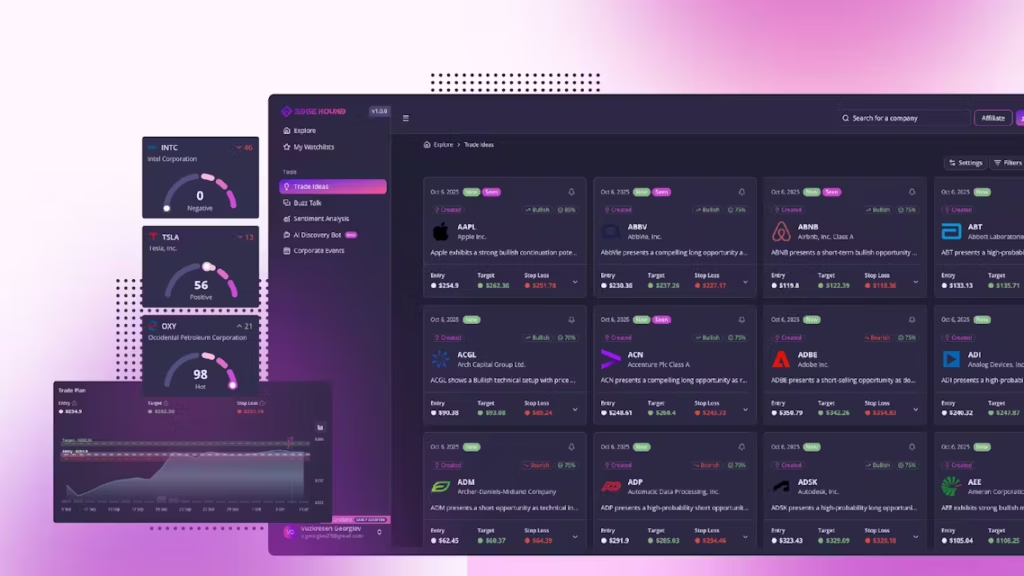
A core pillar of Edge Hound’s architecture is its evolving knowledge graph system. Pavlov explained that traditional analysis often focuses on direct relationships, while overlooking deeper dependencies that can significantly influence valuation and risk.
Edge Hound’s knowledge graphs are designed to capture second- and third-order relationships across businesses and markets. These include supply chain exposure, regulatory linkages, executive-level behavioral patterns, and sensitivity to macroeconomic factors.
While this system is still in beta, Pavlov said it already highlights how interconnected modern markets have become. One of the main challenges is performance, as deep graphs can slow response times. To address this, Edge Hound is implementing a hybrid architecture in which vector databases operate in parallel with the graph layer, allowing faster retrieval of relevant context without simplifying complex relationships.
Academic Foundations Paired With Market Experience
Edge Hound’s analytical depth is supported by a team with strong academic backgrounds. Pavlov himself spent years lecturing in computer science at the university level. His co-founder brings a strong mathematics foundation and extensive engineering experience, while senior contributors include experts in nuclear physics, mathematics, and AI engineering.
However, Pavlov emphasized that academic rigor alone is not enough. Both founders have been active participants in financial markets for years, helping ensure that the platform remains grounded in real-world investing challenges.
Even as AI capabilities advance, Pavlov believes human oversight will always remain essential. Capital allocation decisions involve real consequences and responsibility cannot be fully delegated to automated systems.
Teaching Investors How to Use AI Responsibly
One of the key lessons from Edge Hound’s early testing was the importance of user education. During trials with around 4,000 users, the company found that even intuitive tools can be misunderstood without proper guidance.
As a result, Edge Hound is developing educational resources, including tutorials and best-practice guides, to help users interpret AI-generated insights correctly. Pavlov stressed that the platform takes the risk of AI insights being misinterpreted as financial advice very seriously. Multiple layers of disclaimers reinforce that Edge Hound provides analysis, not instructions.
A Hybrid Future for Investing
Looking ahead, Pavlov outlined a roadmap focused on expanding analytical depth and market coverage. Edge Hound plans to broaden coverage across US equities, followed by expansion into European and Asian markets. ETFs, Forex and CFD instruments, crypto assets, and advanced scenario analysis tools are also part of the roadmap for the upcoming months.
Pavlov is convinced that AI will fundamentally reshape investing, but not in the simplistic way many expect. The future, he said, will be hybrid. AI will handle the heavy analytical work, while humans provide judgment, context, and responsibility. That balance sits at the core of what Edge Hound is building.
Disclaimer: This is an article written by Edge Hound, Fintechnews does not endorse and is not responsible for or liable for any content, accuracy, quality, advertising, products or other materials on this page. Readers should do their own research before taking any actions related to the company. Fintechnews is not responsible, directly or indirectly, for any damage or loss caused or alleged to be caused by or in connection with the use of or reliance on any content, goods or services mentioned in the press release.
Please note this is no investment advice.
Featured image: Edited by Fintech News Switzerland, based on image by smartmalik6384 via Freepik