



Paytech was the top-performing fintech vertical in Europe in Q3 2025, securing an estimated EUR 896 million in growth and venture capital (VC) funding, according to new data released by Finch Capital, a growth investor specializing in business and fintech innovation.
The figure is more than double (117%) what was raised in Q2 2025 at EUR 413 million, marking a strong rebound.

Driving this surge was large funding rounds raised by established ventures. Rapyd, a fintech-as-a-service provider offering global payment infrastructure, raised an additional US$25 million from XBO Ventures, the investment arm of XBO.com, to its US$500 million Series F in September. The deal will see Rapyd integrate XBO’s crypto services, including liquidity solutions, crypto payment processing, and crypto-as-a-service, into its network.

Fnality, which operates next-generation wholesale payment systems regulated by central banks, secured in September a US$136 million Series C to expand its distributed ledger technology (DLT)-based global settlement network. Fnality, which counts among its shareholders the likes of Banco Santander, Barclays, BNP Paribas, Citi Group, Commerzbank, Euroclear, Goldman Sachs, ING, Mizuho Financial Group, Temasek, and UBS, aims to connect traditional finance with the rapidly growing world of tokenized assets and digital payments.
Klarna IPO drives paytech surge
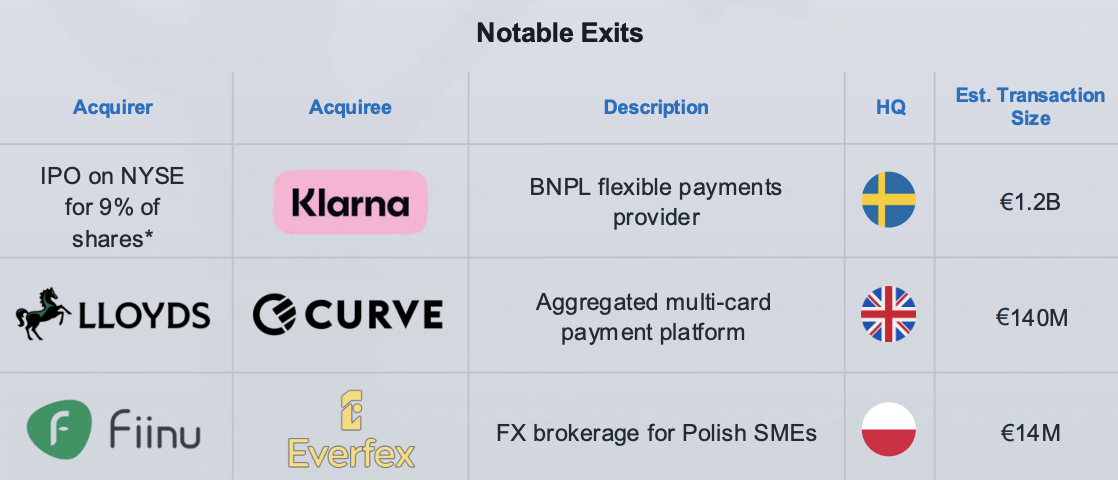
The sector’s momentum was fueled by Klarna’s initial public offering (IPO) and public listing on the New York Stock Exchange (NYSE).
Klarna sold 34.3 million shares to investors at US$40 a share late on September 09, raising approximately US$1.37 billion. This made it the fourth-largest IPO of the year, according to Renaissance Capital, and the biggest offering for a company funded by VC by deal size.
Shares of Klarna opened 30% above their offer price in their NYSE debut on September 10, giving the Swedish fintech a valuation of US$19.65 billion.
Klarna reported its fifth consecutive quarter of operational profitability in Q2 2025, with adjusted operating income reaching US$29 million. It posted a revenue of US$823 million, 111 million active Klarna consumers, and 790,000 merchant partners, including Uber, H&M, Saks, Sephora, Macy’s, Ikea, Expedia Group, Nike and Airbnb.
Klarna provides short-term buy now, pay later (BNPL) consumer loans, and payment processing services for the e-commerce industry, managing store claims and customer payments. The company is currently transitioning to become a digital bank.
Besides the Klarna IPO, other notable exits in the paytech vertical included the EUR 140 million acquisition of digital wallet platform Curve by Lloyds Banking Group, the UK’s biggest high street lender. The deal is part of Lloyds Banking Group’s strategy to expand deeper into payments infrastructure.
Banking and digital currency vertical records steady growth
Banking and digital currency was another prominent fintech vertical in Q3 2025, with growth and VC funding rising 22% quarter-on-quarter (QoQ) to EUR 219 million.
Notable transactions included:
- Treasury, a Bitcoin treasury company from the Netherlands, which secured EUR 126 million (US$147 million) from the VC firm of billionaires Cameron and Tyler Winklevoss to acquire more than 1,000 bitcoins as it seeks to become the largest publicly traded European bitcoin treasury company;
- PBK Miner, a UK cloud mining platform, which raised a US$80 million Series B in July to enhance its global network of renewable energy data centers and develop artificial intelligence (AI) mining systems; and
- M0, a Swiss stablecoin platform, which raised a US$40 million Series B in August to launch custom stablecoins with interoperable liquidity and full on-chain programmability.
Insurtech sees notable exits
Insutech was another standout vertical in Europe, driven by major mergers and acquisitions (M&A) activity.
In September, Radian acquired Inigo for a staggering EUR 1.5 billion. The acquisition, expected to close in early 2026 pending regulatory approvals, will allow Radian to deploy excess capital into new insurance and reinsurance markets while leveraging Inigo’s strong data-driven underwriting platform and Lloyd’s market presence.
Radian is a prominent mortgage insurer in the US, while Inigo is a global specialty insurance and reinsurance company based in London, underwriting through Lloyd’s Syndicate 1301, and serving some of the world’s largest commercial and industrial enterprises.
Also in September, Applied Systems acquired Cytora, a UK-based AI-powered risk analytics and underwriting platform, for EUR 150-300 million, according to Finch Capital. The deal will Applied Systems integrate Cytora’s advanced AI technology with its suite of solutions for insurers, agencies, and managing general agents (MGAs).
Cytora is a configurable platform that enables carriers, MGAs, and brokers to digitize their intake and streamline the full policy lifecycle, from submission to claims servicing, mid-term adjustments, endorsements, and renewals. Applied Systems is a leading global provider of cloud-based software that powers the business of insurance.
Insurtech growth and VC funding reached EUR 258 million in Q3 2025, up 25% QoQ. The figure puts insurtech among the biggest recipients of VC funding during the quarter, ahead of banking and digital currency, as well as wealthtech.
Key VC transactions included:
- Wefox from Germany, which secured EUR 151 million comprising a EUR 76 million capital raise and EUR 75 million in refinancing, to build out its strong market positions in Austria, the Netherlands, and Switzerland and to develop its asset-light MGA and smart insurance distribution businesses internationally; and
- Trasti, a Polish insurtech company, which raised US$24.3 million from the European Bank for Reconstruction and Development (EBRD) and the Triglav Group, to enhance its digital insurance offerings, focusing on motor insurance policies, improving its reach in the property and casualty segments, and expanding its technological capabilities. Trasti also plans to elevate its corporate governance standards by implementing the IFRS accounting standards and refine its reporting framework to align with international norms.
European fintech funding remains resilient
European fintech growth and VC funding remained stable in Q3 2025, totaling EUR 1,711 million and declining by a slight 5% QoQ from EUR 1,799 million in Q2 2025.
The Finch Capital report also analyzed the public fintech market using its Finch Index. The Finch Index is a proprietary benchmark designed to track the performance of nine key business and fintech themes, serving as an industry-specific valuation comparison alongside established indices, such as the S&P 500 and the Nasdaq 100. The index is composed of 90 publicly traded companies, with eight to ten representative firms across each theme to ensure a diversified and balanced view of market trends.
Looking at each of these key verticals, the report shows that wealthtech and capital markets continued to lead the public fintech landscape in Q3 2025.
The vertical posted an enterprise value (EV)/EBITDA (earnings before interest, taxes, depreciation and amortization) multiple of 24.1x, and a EV/Revenue multiple of 7.8x, both the highest among fintech verticals.
High EV/EBITDA and EV/Revenue multiples reflect high investor confidence in profitability, growth potential, and resilience in the industry. Wealthtech and capital markets often command higher multiples because of their scalable digital platforms, and high margins, and attract strong investor sentiment due to innovation or recurring fee income.

Featured image: Edited by Fintech News Switzerland based on image by lekhawattana via Freepik